A-Level Economics in Year 12: What the First Year Actually Covers and the Mistakes Students Make Early On
Your child came home in September saying they'd picked Economics for A-Level. By half-term, they're wrestling with elasticity formulas and drawing supply and demand curves for the third time that week. This isn't the subject they thought they'd signed up for — and that gap between expectation and reality is where a lot of Year 12 economists come unstuck.
Here's what the first year of A-Level Economics actually involves, where students tend to trip up, and how to spot early on whether your child is genuinely on track.
What Year 12 Economics actually covers
A-Level Economics is split into two halves: microeconomics (the behaviour of individual markets, firms and consumers) and macroeconomics (the economy as a whole — growth, inflation, unemployment, trade). All the major exam boards — AQA, Edexcel (Pearson), OCR and WJEC — cover both, though the ordering and emphasis differ slightly.
In Year 12, students typically work through:
- Microeconomics foundations: the basic economic problem, demand and supply, price mechanism, elasticities (price, income, cross), market failure, externalities, government intervention.
- Macroeconomics foundations: measuring economic performance (GDP, inflation, unemployment, balance of payments), aggregate demand and aggregate supply, fiscal and monetary policy, the objectives of government economic policy.
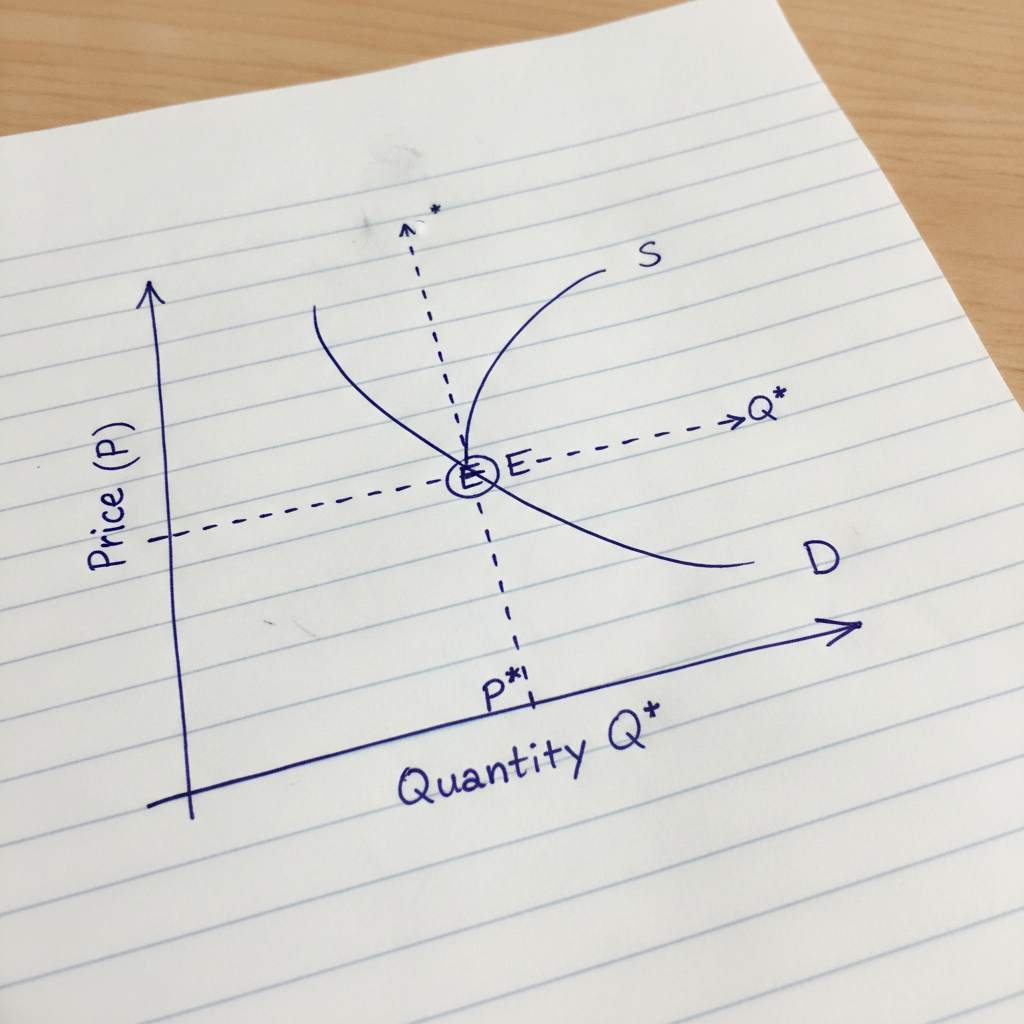
- Diagrams: a lot of them. Students are expected to draw, label and analyse dozens of standard diagrams accurately, from memory, under time pressure.
- Quantitative skills: calculating percentage changes, index numbers, elasticities, real vs nominal values, and interpreting data from tables and graphs. Ofqual requires at least 20% of the total marks across A-Level Economics to come from quantitative skills.
The subject is not about business strategy, entrepreneurship, or reading the Financial Times. Those things help with context, but they don't earn marks on their own.
Why so many students find the first term a shock
Economics attracts a broad mix of students — some come from a strong maths background, some from humanities, some picked it because they enjoyed GCSE Business. The subject rewards a specific blend of skills that few students have all at once:
- Abstract theoretical reasoning. Concepts like opportunity cost, marginal utility and comparative advantage are counterintuitive at first. There's no memorising your way through them — you have to think in models.
- Precise diagram work. A shifted curve labelled wrongly, or an axis without units, loses marks even if the accompanying analysis is correct.
- Applied maths. Not hard maths, but confident maths. Students who avoid numbers at GCSE often struggle when asked to calculate a price elasticity of demand under exam conditions.
- Chains of reasoning. Exam answers require because … which means … which leads to … logic. One-sentence points don't score in the higher bands.
Students who chose the subject expecting essays about current affairs are often the ones who find themselves most adrift by Christmas.
The common early mistakes
A few patterns come up again and again in Year 12:
Treating it like GCSE Business. Economics uses different vocabulary and demands theoretical explanations, not commercial common sense. Answers that describe what a "typical business" would do don't score well against a mark scheme that wants microeconomic theory.
Sloppy diagrams. Unlabelled axes, curves drawn freehand and pointing the wrong way, no title, no equilibrium point marked. Diagrams are worth marks in themselves and support the written analysis — half a diagram is worse than no diagram at all.
Skipping the evaluation. Higher-mark questions (usually 15 and 25 markers) require students to weigh up arguments: it depends on time period, elasticity, assumptions, magnitude. Students who write only one-sided analysis cap themselves at roughly half marks.
Confusing shifts and movements. A change in price causes a movement along a demand curve; a change in income causes a shift of the curve. Getting this wrong in an exam is a giveaway that the underlying model hasn't clicked.
Memorising without understanding. Economics is not a subject you can flashcard your way through. Students who try tend to plateau around a grade C.
Reading the mock marks
Most schools run internal assessments at October half-term, Christmas, and Easter. The raw marks can be misleading because papers vary in difficulty, so pay more attention to:
- The grade boundary the mark corresponds to. Ask the teacher, or check the exam board's published boundaries for a similar past paper. An A-Level Economics A grade typically sits around 75–80% on a full paper, but a B on a hard mock paper may only be 55%.
- The breakdown by question type. A student scoring well on the multiple choice and short-answer questions but poorly on the 15- and 25-markers has an evaluation problem, not a knowledge problem. That's a very different fix.
- The pattern between micro and macro. It's common to be stronger in one than the other in Year 12. Persistent weakness in one half by Easter is worth addressing before Year 13, when the content builds directly on Year 12 foundations.
- The teacher's written comments. "Needs more analysis", "diagrams inaccurate", "limited evaluation" all point to specific, fixable weaknesses rather than a general lack of ability.
A student sitting on a D or E at Christmas is not necessarily heading for a D or E at A-Level — the first term is genuinely hard and many students improve markedly once the models click. But a D or E at Easter, with the same feedback repeating, is a sign that something needs to change.
When to intervene, and how
If mock marks are stubbornly low despite your child working hard, the issue is usually one of three things: they haven't understood the underlying models, they can't structure an exam answer to the mark scheme, or they're weak on the quantitative side. Each has a different remedy.
Talking to the class teacher is the first step — they see the work and can be specific about what's missing. If the class is large or the feedback is thin, targeted one-to-one tutoring can help, particularly for essay technique and diagram work, which are hard to fix from a textbook. An hour a week with someone who can watch a student draw a diagram and mark a 15-marker in real time is often more useful than any amount of solo revision.
The bottom line
Year 12 Economics is a demanding subject that punishes vagueness and rewards precise, structured thinking. Most students find it harder than expected in the first term. What matters is whether they're improving by Easter — the students who leave Year 12 confident with the models, the diagrams and the exam technique tend to do well in Year 13. The ones who bluff through the first year almost always come unstuck when the harder synoptic content arrives.
If your child is finding it tough now, that's normal. If they're finding it tough in June, it's worth acting on.