GCSE Chemistry: The Calculation Questions That Catch Students Out — and How to Fix Them
If your child came out of a GCSE Chemistry mock saying "the calculations went badly", they're in large company. Every year, examiner reports from AQA, OCR and Edexcel highlight the same pattern: students who can explain bonding, describe reactions and recall equations lose a disproportionate share of their marks on the quantitative questions. These are the questions worth practising over the summer, because they are predictable, learnable, and often the difference between a grade 6 and a grade 8.
Why calculation questions cost more marks than they should
Chemistry calculations reward a specific habit of mind: setting the problem out carefully, tracking units, and checking the answer against the chemistry. Students who rush — or who try to hold the whole calculation in their head — make small arithmetic slips that cascade. Examiners consistently flag the same errors:
- Forgetting to balance the equation before using it in a moles calculation.
- Confusing Mr (relative formula mass) with Ar (relative atomic mass).
- Using the wrong reactant when one is in excess.
- Rounding too early, so the final answer is out by a decimal place.
- Not showing working, so partial credit is lost when the final answer is wrong.
Most of these are habits, not knowledge gaps. That's good news — habits can be fixed with a few weeks of focused practice.
The calculation types that appear every year
The GCSE Chemistry specifications (AQA, OCR Gateway, OCR 21st Century, Edexcel) all cover broadly the same quantitative content. The exact paper split varies by board, but the following question types will appear somewhere across the two papers.
Paper 1 territory
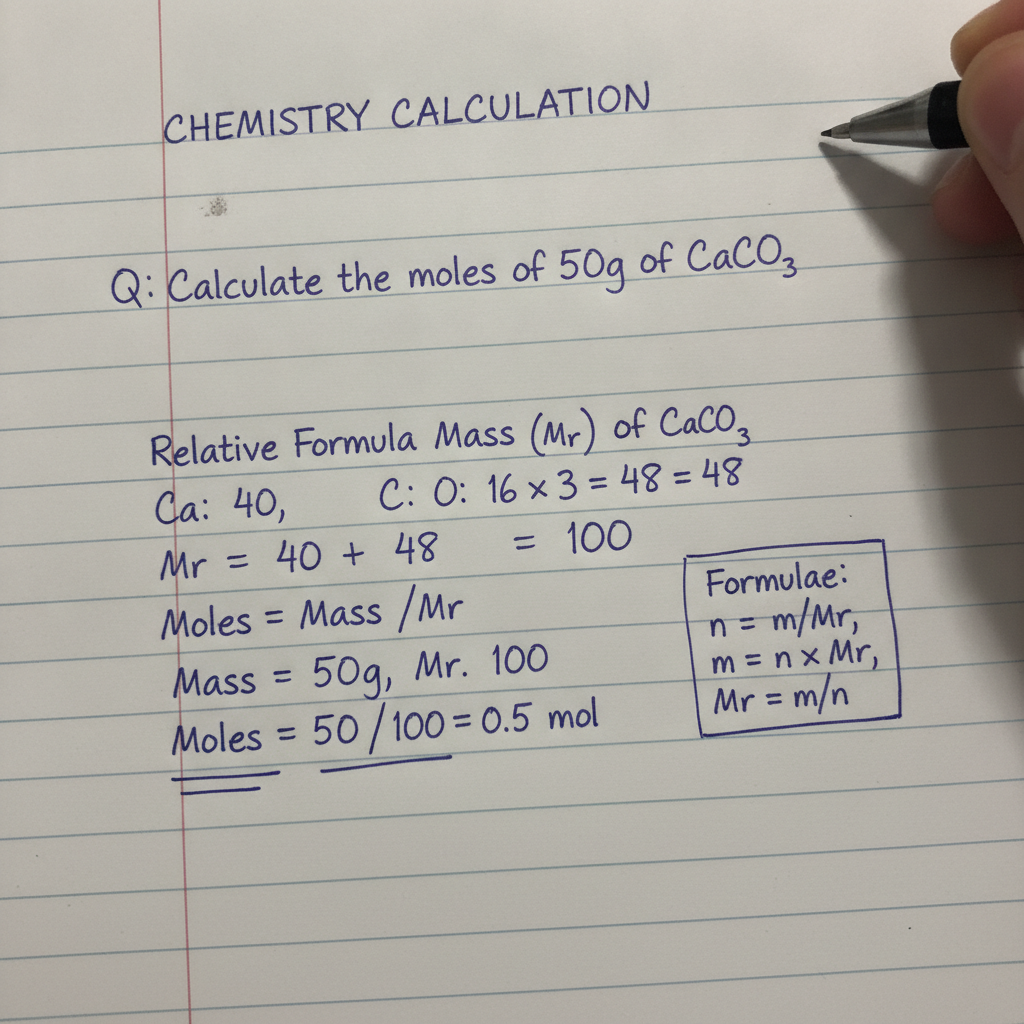
Relative formula mass (Mr). The foundation. Every calculation that follows depends on getting Mr right. Errors usually come from miscounting atoms in brackets — for example, in Ca(OH)₂, students forget to double the H as well as the O.
Moles from mass. Using n = m ÷ Mr. Straightforward in isolation, but often embedded inside a longer question where the student has to spot that a moles step is needed.
Reacting masses. Given a balanced equation and the mass of one substance, calculate the mass of another. This is where an unbalanced equation quietly destroys the answer.
Concentration of solutions. In g/dm³ at Foundation, and in mol/dm³ at Higher. Watch for cm³ to dm³ conversions — dividing by 1000 is where a lot of marks disappear.
Paper 2 territory
Percentage yield. (actual yield ÷ theoretical yield) × 100. The theoretical yield step is the trap — students often calculate it from the wrong reactant, or forget to convert moles back to mass.
Atom economy. (Mr of desired product ÷ sum of Mr of all products) × 100. Conceptually simple, but students confuse it with percentage yield or use masses from the question instead of Mr values from the equation.
Titration calculations (Higher only). Multi-step: moles of the known solution, moles of the unknown via the equation ratio, then concentration. Errors compound across the three steps.
Gas volumes at RTP (Higher only). 1 mole of any gas occupies 24 dm³ at room temperature and pressure. The number itself is easy to remember; knowing when to use it is harder.
What examiners actually want to see
Examiner reports (published each year on each board's website after the summer series) are unusually blunt about calculations. Three points come up repeatedly:
- Show every step. Method marks are available even when the final answer is wrong. A student who writes only the final number gets nothing for a slip.
- Give answers to the right number of significant figures. Usually 2 or 3 sig figs, matching the data in the question. Answers given to six decimal places suggest the student doesn't understand precision.
- Include units. Marks are frequently withheld for a numerically correct answer with the wrong or missing unit.
These are easy points to bank once a student knows to look for them.
A systematic summer plan
Six to eight weeks is enough time to move calculations from a weakness to a strength, if the practice is deliberate rather than passive. Reading through worked examples is not practice. Doing questions under timed conditions and marking them honestly is.
A workable structure:
- Week 1–2: Drill Mr and moles from mass. Twenty short questions per session, three sessions a week. No calculator gymnastics — the arithmetic is meant to be simple; the discipline is in setting it out.
- Week 3–4: Reacting masses and concentrations. Move to past paper questions, one paper's worth of calculation questions per session.
- Week 5–6: Percentage yield, atom economy, and (for Higher) titrations and gas volumes. Mix question types so the student has to identify which calculation is needed, rather than knowing in advance.
- Week 7–8: Full past-paper calculation sections under exam timing. Mark against the mark scheme. Keep a written log of every error and its cause — arithmetic slip, wrong equation, wrong unit, misread question. Patterns emerge quickly.
Past papers from the last five years are freely available on each exam board's website, along with mark schemes and examiner reports. Working through the calculation questions across all three major boards (not just your child's own) gives more practice material and exposes the same concepts phrased in different ways.
When a tutor helps and when it doesn't
If your child understands the chemistry but keeps making arithmetic or setting-out errors, they mostly need volume of practice and honest self-marking — not a tutor. If they don't know where to start on a moles question, or can't tell a percentage yield question from an atom economy one, a few sessions with a tutor to rebuild the underlying method can be more efficient than months of frustrated self-study. The distinction matters: paying for tutoring when the real issue is practice volume rarely fixes the problem.
The bottom line
GCSE Chemistry calculations are the most predictable part of the paper. The question types repeat, the errors repeat, and the fixes are known. A student who spends part of the summer building the habit of showing working, tracking units and checking against a balanced equation will walk into the exam with a real advantage over one who has revised the content but not the technique.