GCSE Physics: The Topics Where Students Drop the Most Marks — and Why It's Rarely About the Maths
If your child brings home a Physics mock with 62% and mutters something about "the maths", it's worth pausing before booking a maths refresher. Examiners' reports from all the major boards — AQA, Edexcel, OCR — say the same thing year after year: the marks students lose in GCSE Physics are mostly lost on the written questions, not the calculations. The equations are usually fine. It's the explain, describe and evaluate questions where answers fall apart.
Understanding this changes what "revision" should actually look like.
Where the marks actually go missing
Physics papers are a mix of multiple choice, short calculations, longer calculations, practical-based questions, and extended written responses (often 4- or 6-mark "explain" or "evaluate" questions). The calculation marks tend to be won or lost cleanly — a student either knows to rearrange V = IR or they don't, and the marks come back quickly with practice.
The written questions are different. They're where a student can write half a page, feel like they've said something sensible, and still score 1 out of 4. Three topics repeatedly show up in examiners' reports as the biggest culprits:
- Electricity — particularly explanations involving series and parallel circuits, resistance, and the National Grid.
- Forces — especially stopping distances, terminal velocity, and momentum in Higher tier.
- Waves — refraction, the electromagnetic spectrum, and required practicals involving ripple tanks or ray boxes.
These are not the hardest topics conceptually. They're the topics where the questions demand a precise chain of reasoning, and vague answers get almost nothing.
What examiners actually want
A GCSE Physics "explain" question is not asking for a description of what happens. It's asking why it happens, using the right physics vocabulary, in a logical sequence.
Take a common electricity question: Explain why the resistance of a filament lamp increases as the current through it increases.
A typical Grade 4–5 answer looks like this:
"The current makes the lamp get hotter and the resistance goes up because it's hotter."
That's a description, not an explanation, and it scores 1 mark at best. The full-mark answer needs a chain:
- The current causes the filament to heat up.
- The metal ions in the filament vibrate more.
- Electrons collide with the ions more frequently.
- This makes it harder for charge to flow, so resistance increases.
Four linked steps, each using the correct terminology. That's the pattern examiners are looking for on almost every extended written question: cause → mechanism → consequence, expressed in the language of the specification.
The same applies to "evaluate" questions, which additionally require the student to weigh points against each other and reach a supported conclusion. A student who lists three advantages and three disadvantages of nuclear power but never actually decides anything will lose the top marks.
Why re-reading notes doesn't fix this
Most students revise by reading through their notes, watching a video, and perhaps doing a few past-paper calculations. This builds a comfortable familiarity with the topic — which is exactly the problem. Familiarity is not the same as being able to produce a structured written answer under timed conditions.
When the exam question appears, the student recognises the topic, feels confident, and writes what they remember rather than what the question demanded. They lose marks not because they don't know the physics, but because they've never practised converting what they know into the specific answer format the mark scheme rewards.
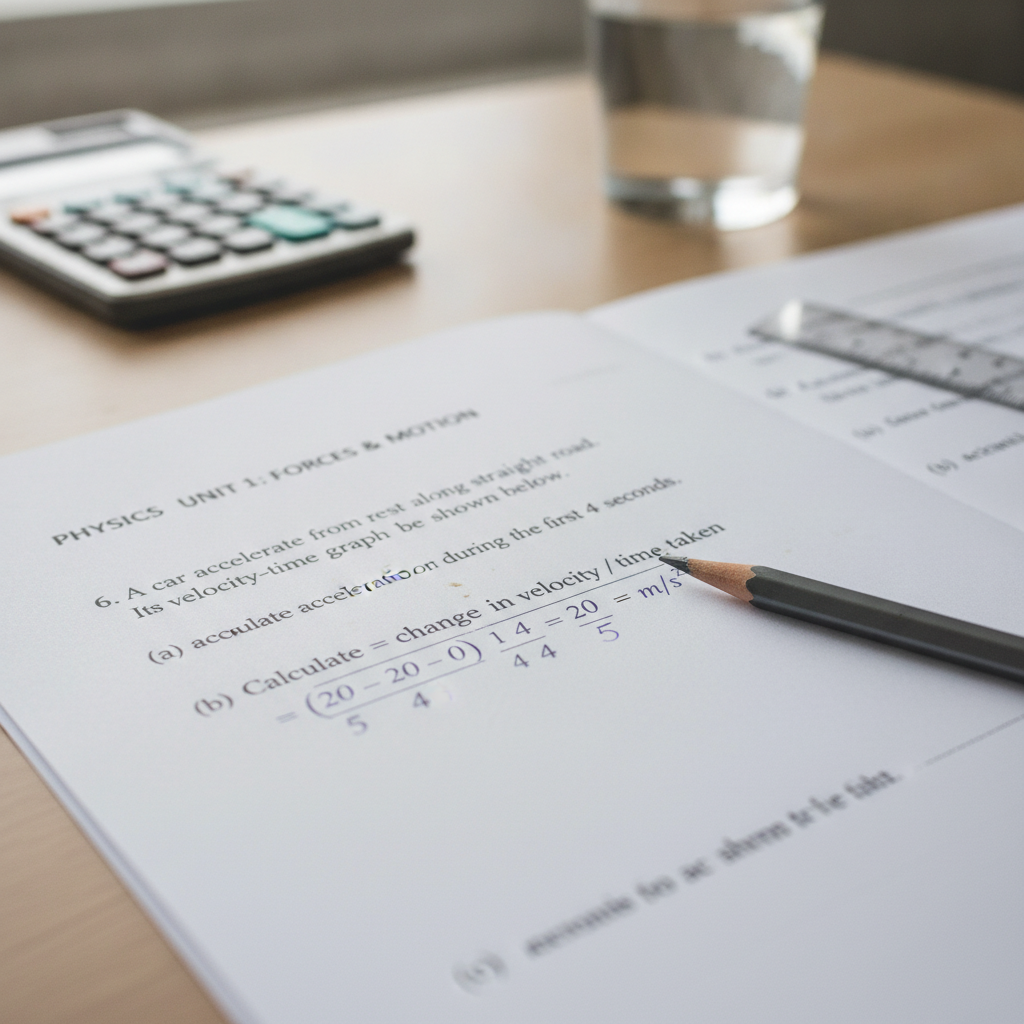
What targeted practice looks like
Effective preparation for the written questions is quite different from general revision. It involves:
- Working from the mark scheme, not just the question. After attempting a 6-marker, the student should read the mark scheme line by line and identify which specific points they missed and why.
- Learning the standard "chains" for each topic. For electricity, that means being able to reel off the resistance-and-temperature chain, the transformer/National Grid chain, and the series-vs-parallel reasoning without hesitation.
- Practising the command words. Describe wants observations. Explain wants mechanisms. Evaluate wants a judgement. Students who mix these up leak marks on every paper.
- Writing under time pressure. A 6-mark question should take roughly seven to eight minutes. Students who spend fifteen minutes on it in revision are not simulating the exam.
- Focusing on the required practicals. Every board has a set list, and questions on them appear reliably. Students should be able to describe the method, the variables, and the sources of error in each one.
This kind of practice is dull compared to watching a video, which is partly why students avoid it. It's also where the actual grade improvement lives.
When to bring in outside help
If your child is scoring well on the calculation questions but losing marks consistently on the written ones, the issue is almost certainly technique rather than understanding. A subject-specialist tutor can be particularly useful here because they've seen hundreds of these answers and can spot immediately where a student's reasoning is skipping steps. That's a very different job from re-teaching the content, and it's usually a shorter piece of work than parents expect — often a handful of focused sessions on written-answer technique across the three problem topics.
If, on the other hand, the calculations are the sticking point, the fix is different: more equation practice, better rearrangement habits, and cleaner unit-tracking. Both problems are solvable; they just need to be diagnosed correctly first.
A practical next step
Take your child's most recent Physics mock or past paper and look only at the extended written questions. For each one, compare their answer to the mark scheme and count how many of the mark-scheme points they actually hit. If the pattern is "knows the topic, hits one or two points, misses the rest", you've found where the grade is being lost — and it isn't the maths.