Post-16 Qualifications Are Changing: What It Means If Your Child Starts Sixth Form in 2027
Wait — current Year 11s starting sixth form in 2027 means they're in Year 10 now (autumn 2025/2026). Let me think: the brief says "child starts sixth form in 2027" and addresses "parents of current Year 11s." If they start sixth form in Sept 2027, they're currently in Year 10. But the brief explicitly says Year 11. I'll go with the brief — perhaps the parent's Year 11 is finishing this academic year and starting sixth form Sept 2027 (meaning they're in Year 11 right now in 2026/27 academic year). That works.
The DfE published a Post-16 Pathways Implementation Plan "2 weeks ago" per the search results. I'll write accordingly.
The first new post-16 qualifications land in classrooms in September 2027 — the same month your Year 11 is likely to walk into sixth form or college. That timing is not a coincidence. The Department for Education has been reshaping the Level 3 landscape (the qualifications students take between 16 and 18) for several years, and the changes are now firming up into something parents can actually plan around.
Here is what is settled, what is still moving, and what it means for the GCSE choices and post-16 conversations happening at your kitchen table right now.
The headline change: a third pathway called V Levels
For decades, the post-16 picture has been broadly two-track: A Levels for the academic route, and a sprawling mix of BTECs, Cambridge Technicals and other applied general qualifications for the vocational route. T Levels were added in 2020 as a two-year technical alternative tied to industry placements, but uptake has been slower than ministers hoped.
The government's answer is a new qualification called the V Level. V Levels will launch in three subjects from September 2027, the Department for Education has confirmed, and they have been designed so a student can take them alongside A Levels. Ministers have also decided to design V Levels to the same qualification size as one A Level – 360 guided learning hours – so that students can choose to take a "mix and match" selection of vocational and academic qualifications.
The three first-wave subjects are digital, education and early years, and finance and accounting. More will follow in waves through to the end of the decade.
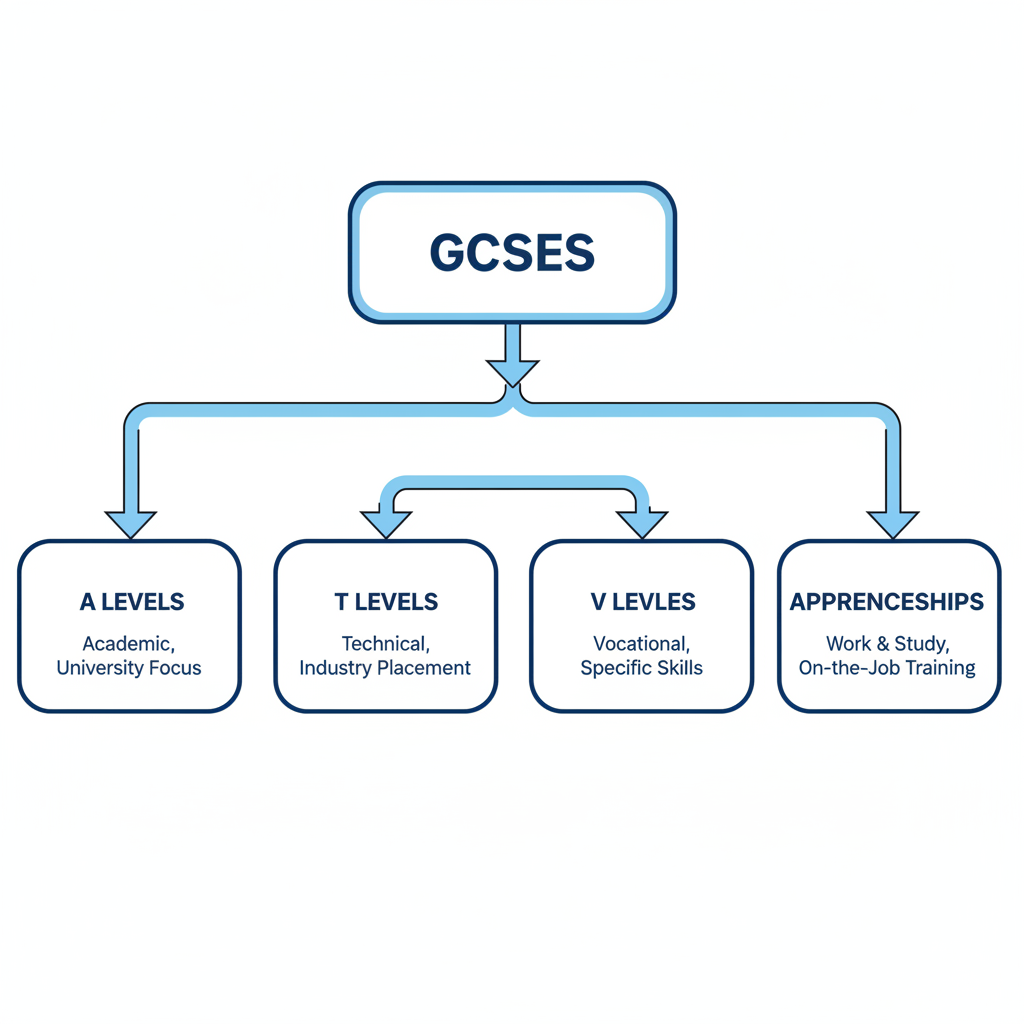
So by 2027, the post-16 menu looks like this:
- A Levels — academic, two years, largely unchanged
- T Levels — technical, two years, equivalent to three A Levels, with an industry placement
- V Levels — vocational, one-A-Level-sized, can be mixed with A Levels or stacked together
- Apprenticeships — work-based, paid, leading to a recognised qualification
What's actually being phased out
This is the part that has caused the most noise in staffrooms. The plan to defund large numbers of existing BTECs and applied general qualifications has been controversial, and the timing has now slipped.
Popular BTECs and other applied general qualifications have been granted another funding extension as part of a 'sustainable' transition to new V-levels. Defunding will now begin from autumn 2027, instead of this year, in finance, digital, education and early years – the subject areas chosen for the first V-levels.
In other words: in the three subject areas where V Levels exist from 2027, the equivalent BTECs will start losing funding. In every other subject area, BTECs and similar qualifications continue to be funded until their V Level replacement is ready — a process the DfE has staged across several years to 2030/31.
The Sixth Form Colleges Association had pushed hard for this delay. Around 50,000 16-year-olds were affected. Under the government's original plan, these qualifications would have been scrapped in August 2026 and August 2027 – before V levels in the same subjects had been ready.
One other change worth noting: the T Level Foundation Year, which gave students who weren't quite ready for a full T Level a one-year stepping-stone, is being discontinued and replaced by new Foundation Certificates as part of the same reform package.
What this means for your child's GCSE choices
If your child is in Year 11 now and heading to sixth form or college in September 2027, they will be among the first cohorts to choose under the new system. The good news is that the principles for GCSE option choices haven't changed — they've just become slightly more important.
English and maths remain the gatekeepers. Every post-16 route requires a grade 4 in GCSE English and maths, and students who don't have them must keep resitting. This is true for A Levels, T Levels, V Levels and most apprenticeships. If either subject is shaky, that is the priority between now and the summer exams.
Don't narrow too early. The mix-and-match design of V Levels means a student no longer has to choose "academic" or "vocational" at 16. A teenager who likes maths but also wants to train in accounting could, from 2027, take two A Levels alongside a Finance and Accounting V Level. That flexibility is genuinely new, and it rewards students who keep options open at GCSE rather than dropping, say, a humanity or a language too quickly.
Triple science is still worth it if they can manage it. Health and science V Levels are coming in a later wave, and existing T Levels in healthcare and science already favour students with strong science GCSEs. Combined science is fine for most pathways, but triple keeps the door wider open.
For the digitally inclined, the new Digital V Level is one to watch. If your child is considering a future in IT, software or data, the 2027 V Level in Digital is being positioned as a genuine alternative to A Level Computer Science — and as a route into either employment or a degree apprenticeship. Strong GCSEs in maths and computer science (or DT) will help.
Universities are still the main destination. Around 71% of 16-year-olds on Level 3 programmes are taking A Level routes, and university admissions tutors are most familiar with A Levels and, increasingly, T Levels. V Levels are explicitly designed to carry UCAS points, but they are new, and the first cohort will be the first test of how selective universities treat them. For a child with their heart set on a competitive course at a Russell Group university, A Levels remain the safest bet.
What is still uncertain
The DfE has been clear that the broad direction of travel is fixed, but plenty of detail is still being consulted on. The Curriculum and Assessment Review, led by Professor Becky Francis, has been running in parallel and may yet nudge things further. The full content specifications for the first V Levels are still being finalised by awarding organisations, and the list of which specific legacy qualifications lose funding in 2027 has only just been published.
If your child's current sixth form or college is heavily invested in BTECs, it is reasonable to ask the head of sixth form directly: which qualifications do you plan to offer in September 2027, and which are you withdrawing? Most schools are already working this out, and an open evening this spring is the right moment to ask.
A sensible plan between now and Year 12
For a Year 11 family right now, the practical steps are short:
- Secure grade 4 or above in GCSE English and maths. Everything else depends on it.
- Keep at least one essay-based subject and one quantitative subject going strongly, so A Level options stay open.
- Visit sixth forms and colleges this term and next, and ask specifically about their 2027 offer — not just their 2026 prospectus.
- If your child is leaning vocational, look at whether the V Level subject areas opening in 2027 match their interests. If they do, that pathway will be cleaner than it has been for any previous cohort. If not, the existing BTEC routes are still funded for now.
- Treat any "T Level Foundation Year" listed in current prospectuses with caution — it is being wound down.
The system your child enters in 2027 will look different from the one their older siblings or cousins navigated, but the underlying advice has not changed much. Keep options broad, prioritise English and maths, and choose a sixth form or college that is honest about how it is adapting. The qualifications are being reshuffled. The principles for getting the most out of them are not.