Why I Tell My Students to Watch Cartoons the Night Before an Exam
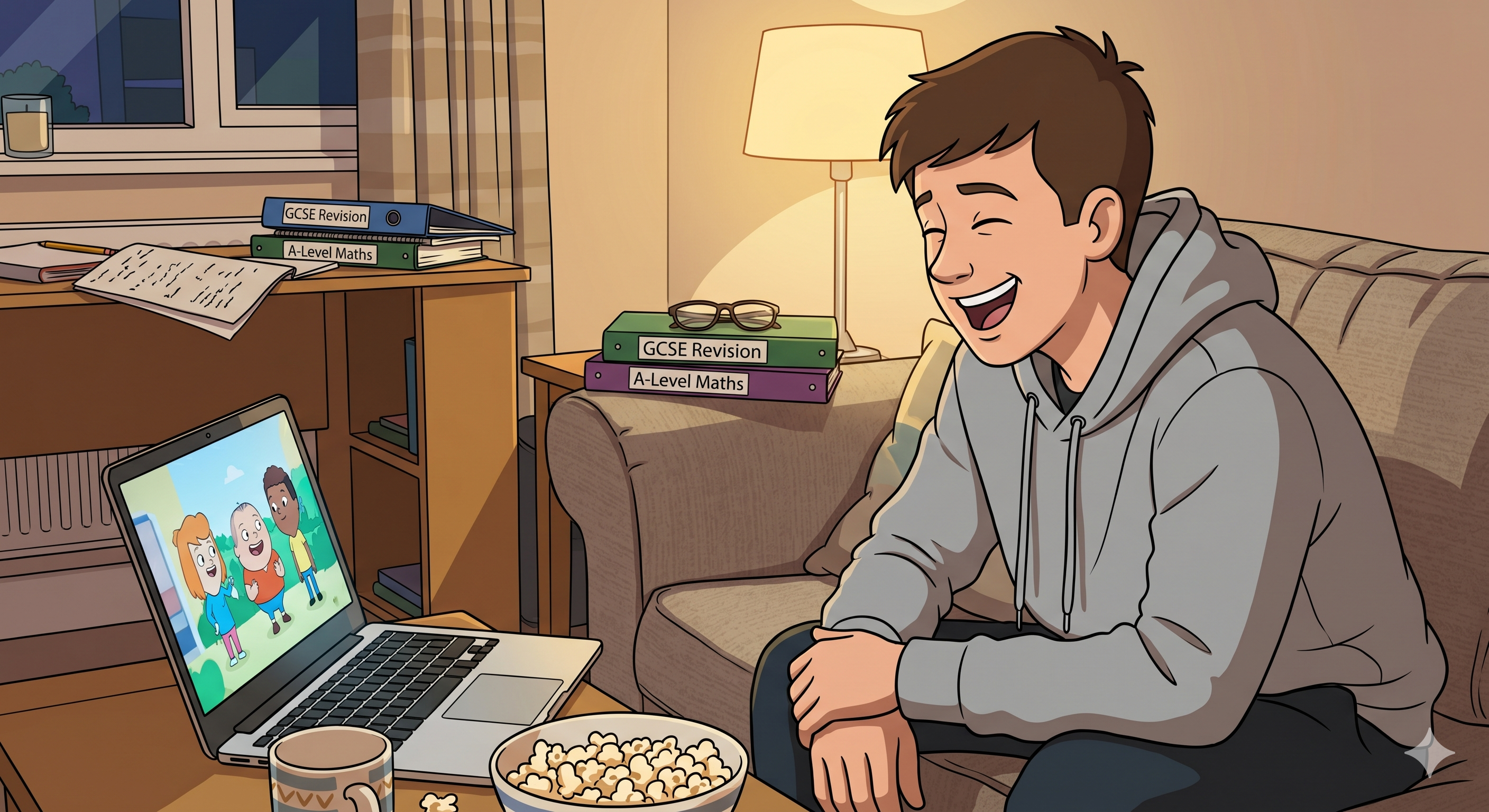
If you've ever taught a teenager in the 24 hours before a maths or computer science exam, you'll know the look. The slightly glassy eyes. The textbook open at a page they're not reading. The quiet panic of someone trying to cram a year of trigonometry, recursion, or Big O notation into one sleepless evening.
As a private tutor who works with GCSE and A-Level students, I've come to believe that the most useful thing I can say to a student the night before an exam isn't about content at all. It's this: eat properly, get a good night's sleep, and watch some cartoons.
The premise is simple. If you're not ready by the night before, you're not going to be ready. What is still within your control — what will genuinely shift the needle on your performance — is how calm, rested, and clear-headed you feel when you sit down in that exam hall. Stress and anxiety are the enemies now, not the gaps in your knowledge.
And of all that advice, the one that gets the most raised eyebrows is the cartoons. So let me explain why I think it's the one with the strongest evidence behind it.
Laughter measurably reduces stress hormones
This isn't woolly wellness talk. The link between laughter and reduced cortisol — the hormone that drives the "I can't think straight" feeling students get before an exam — is one of the better-replicated findings in stress research.
In 2023, PLOS ONE published a systematic review and meta-analysis of interventional studies looking specifically at what happens to cortisol levels when people laugh. The headline result: spontaneous laughter reduced cortisol by an average of 31.9% compared to control groups. When researchers looked specifically at studies where a single laughter session was used — which is exactly the scenario we're talking about on exam eve — the drop was even larger: 36.7%.
Five of the eight studies in that meta-analysis used watching a humour or comedy video as the intervention. In other words, the evidence base isn't built on laughter yoga or comedy clubs alone. It's built, in significant part, on people sitting on a sofa watching funny things on a screen.
A separate strand of research from Dr Lee Berk at Loma Linda University has been investigating this for decades. His team has consistently shown that humour and laughter reduce cortisol and adrenaline (epinephrine), while increasing endorphins — the body's own feel-good chemicals — and even boosting immune markers like antibody production. The mechanism is well understood: laughter activates physiological systems that pull you out of fight-or-flight mode and into something closer to rest-and-recover.
You start benefiting before you even press play
Here's where it gets interesting for the exam-eve scenario.
In one of Berk's most striking studies, researchers measured stress hormones in healthy adults who were simply told they were going to watch a funny video. Before they'd watched a single frame, their stress hormones were already dropping. Cortisol fell by 39%, adrenaline by 70%, and dopac (a chemical involved in producing adrenaline) by 38% — all compared to a control group.
In other words: anticipation alone of a laughter event reduces stress hormones.
For tutors, this is gold. It means the moment a student decides "tonight, after dinner, I'm watching two episodes of Adventure Time," they've already begun unwinding the cortisol spike. The benefit kicks in before the cartoon does.
Familiar, predictable content lowers cognitive load
There's a second mechanism at work here, and it's why I specifically say "cartoons" rather than "any funny film."
Media psychology research on what's now called comfort television has shown that familiar narratives and predictable outcomes function as tools for emotional regulation. Viewers feel more at ease when they're engaging with known storylines and characters. Crucially, rewatching familiar content requires significantly less cognitive effort than processing new or complex material — making it especially appealing during periods of mental fatigue.
This is exactly the state your students are in the night before an exam. Their working memory is shot. Their executive function is fried. The last thing they need is to start a gritty new drama where they have to track seven characters and a political subplot. What they need is the cognitive equivalent of a warm bath: something they already know, that doesn't demand anything, that lets the brain idle.
Cartoons are almost perfectly engineered for this. They're short. They resolve quickly. They're emotionally bright. Most students have shows from childhood they'll happily slip back into — Bluey, Avatar: The Last Airbender, Gravity Falls, Spongebob, Phineas and Ferb, anything by Studio Ghibli. The familiarity isn't a bug; it's the entire point.
Humour and learning are old friends
There's also a broader body of research worth knowing about, because it underpins why this advice doesn't just calm students — it can genuinely help them perform.
A review published in Advances in Physiology Education summarised decades of work on humour and academic performance and concluded that humour and laughter promote learning by reducing stress, anxiety, and tension, while increasing self-esteem, alertness, creativity, and memory. The same paper notes that humour stimulates multiple physiological systems that decrease stress hormones like cortisol and epinephrine.
Going further, Berk's earlier work on test humour found that introducing playful elements into exam materials significantly lowered student anxiety and improved performance. Nearly all undergraduate students in his studies reported that humour was "extremely effective" at reducing anxiety and "very effective" at helping them do well.
Now, your student isn't going to be making the exam funnier — that's not in their power. But what they can do is walk into that exam hall having spent the previous evening pulling the same lever from a different direction: reducing their cortisol, lifting their mood, and arriving rested.
What I actually tell my students
When a student messages me through the lesson portal the day before their Edexcel A-Level Maths paper asking if they should do one more past paper, my answer is almost always no. I tell them:
You've done the work. Tonight isn't about revision — it's about arriving in good condition. Have a proper dinner. Watch an episode or two of something that makes you laugh, ideally something you've seen before so your brain doesn't have to work for it. Then get to bed at a sensible time.
The cartoons aren't a gimmick. They're a deliberate, evidence-backed intervention to lower the cortisol that would otherwise be sabotaging their thinking the next morning. A 30%-plus drop in stress hormones from one session of genuine laughter is a bigger performance lever, at that stage, than any amount of last-minute revision.
You can't cram knowledge in twelve hours. But you can show up calm. And cartoons, of all things, turn out to be one of the most evidence-based ways to do it.
References
- Kramer, C. K., & Leitao, C. B. (2023). Laughter as medicine: A systematic review and meta-analysis of interventional studies evaluating the impact of spontaneous laughter on cortisol levels. PLOS ONE, 18(5), e0286260.
- Berk, L. S., Tan, S. A., Fry, W. F., et al. (1989). Neuroendocrine and stress hormone changes during mirthful laughter. The American Journal of the Medical Sciences, 298(6), 390–396.
- Berk, L. S., et al. (2008). Cortisol and catecholamine stress hormone decrease is associated with the behavior of perceptual anticipation of mirthful laughter. FASEB Journal, 22(1 Supplement), 946.11.
- Savage, B. M., Lujan, H. L., Thipparthi, R. R., & DiCarlo, S. E. (2017). Humor, laughter, learning, and health! A brief review. Advances in Physiology Education, 41(3), 341–347.