A-Level Maths in Year 12: What the First Half-Term Actually Covers and Why Students Fall Behind Early
The jump from GCSE to A-Level Maths is the sharpest step-up in the sixth form curriculum, and it happens fastest in the first six weeks. Students who coasted to a Grade 7 at GCSE often find themselves genuinely struggling by October half-term — not because the new content is impossibly hard, but because it assumes a level of algebraic fluency most GCSE students never had to demonstrate.
Here's what the first half-term actually covers, where students trip up, and what to look for at home.
What's covered in the first six weeks
Both AQA and Edexcel front-load Year 12 with pure mathematics. The specific ordering varies between schools, but the opening half-term almost always draws from the same pool of topics:
- Algebraic manipulation: expanding, factorising, simplifying algebraic fractions, and working with surds and indices
- Quadratics: completing the square, the discriminant, and quadratic inequalities
- Simultaneous equations, including one linear and one quadratic
- Polynomials: the factor theorem and polynomial division
- Coordinate geometry: straight lines, then circles (equation of a circle, tangents, chords)
- Graphs and transformations: sketching cubics, reciprocals, and applying translations, reflections and stretches
- Functions and inequalities: including set notation for solution sets
Some schools begin trigonometry or introduce differentiation before half-term; others hold those back until November. Either way, the workload in these six weeks is significantly heavier than any comparable period at GCSE. A student might be set two to three hours of independent maths work per week on top of lessons, and that's before any consolidation they need to do on their own.
Why "familiar" content trips students up
Parents often hear their child say the early topics feel like GCSE revision. In one sense, that's true — the words are the same. Quadratics, straight lines, indices. But the treatment is different in three important ways.
Precision matters more. At GCSE, a student who wrote x = 3, -2 for the roots of a quadratic would get the marks. At A-Level, they'll increasingly be asked to give exact answers in surd form, state domains, use correct set notation, or justify why a particular root is rejected. Sloppy notation that scraped a 7 at GCSE gets crossed out.
Steps are compressed. GCSE questions tend to lead students through a problem in parts. A-Level questions expect the student to see the structure themselves. A typical opening question might involve rearranging an expression, spotting it's a hidden quadratic, solving it, and interpreting the result — all in one unlabelled question worth four marks.
Algebraic fluency is assumed, not taught. This is the big one. Teachers move on from a technique the moment they've explained it, because the specification is enormous and they have twelve weeks of pure content to get through before Christmas.
The specific GCSE gaps that cause problems
If a student is going to fall behind before October half-term, it's almost always because of weaknesses in one of these areas:
Fractions with algebra
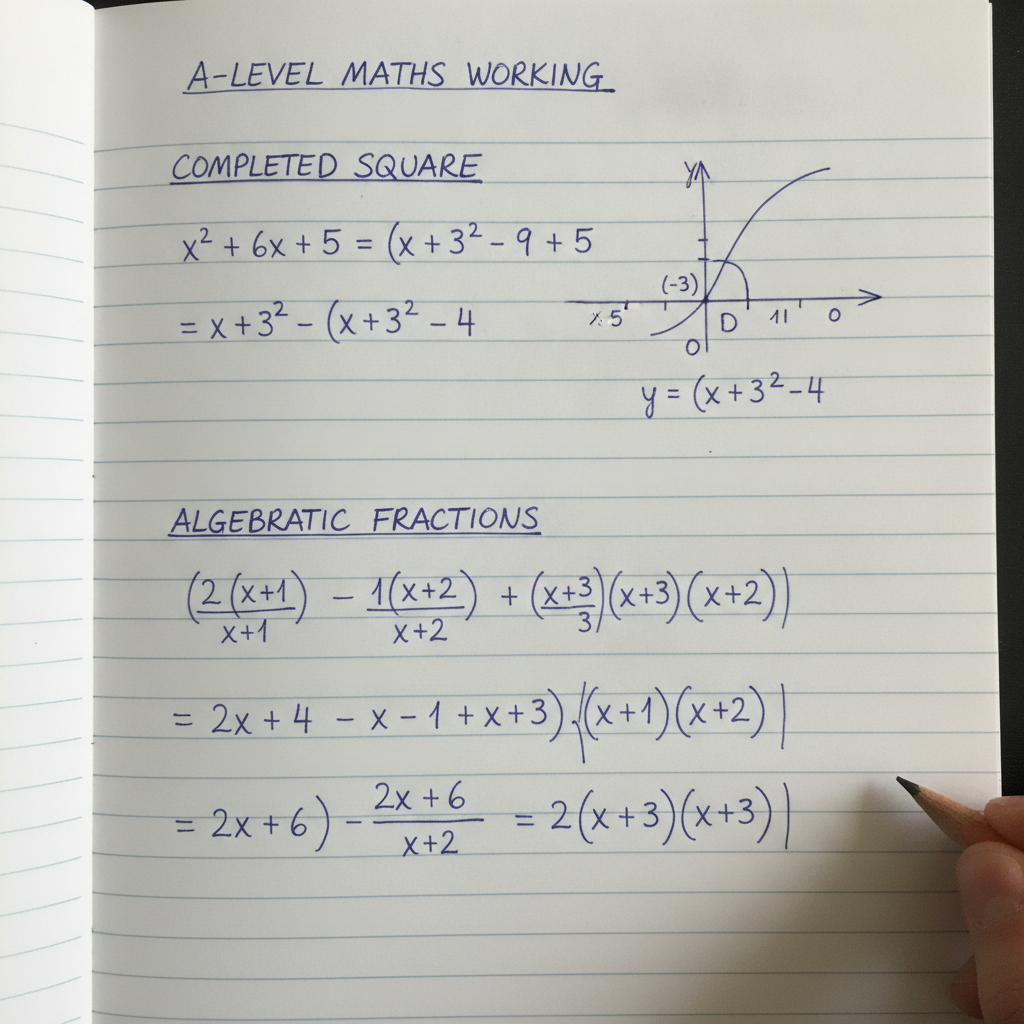
Adding, subtracting and simplifying algebraic fractions is used constantly — in partial fractions later on, in differentiation, in every rearrangement problem. Students who relied on a calculator for numerical fractions at GCSE often can't manipulate algebraic ones fluently.
Indices and surds
Rules like a^(m+n) = a^m × a^n, negative and fractional indices, and rationalising denominators appear in the first fortnight and never go away. A student who can't confidently rewrite 1/√x as x^(-1/2) will struggle the moment differentiation begins.
Completing the square
At GCSE this was a discrete skill for one question. At A-Level it underpins circle equations, quadratic inequalities, transformations of graphs, and eventually integration. Shakiness here creates problems in five different topics.
Rearranging equations with the unknown on both sides, or inside brackets
Coordinate geometry questions frequently demand five or six lines of algebra to reach an answer. A student who makes one sign error per line will get almost nothing right.
Sketching, not plotting
GCSE rewards plotting graphs from a table of values. A-Level requires sketching from the equation — identifying intercepts, asymptotes, and turning points without a grid. Many students have simply never done this before.
What parents can watch for
You don't need to understand the maths to spot trouble early. The signals tend to be behavioural rather than academic.
- Homework taking dramatically longer than expected, or being finished suspiciously quickly with the answers copied from a friend or a solutions website
- A shift from "I get it in class but not at home" — this usually means the student is following worked examples but can't start a problem from a blank page
- Reluctance to show working, or working that's just a list of answers with no lines of algebra between them
- First assessment scores below 50%. Most schools run a short test in late September or early October. A mark that would have been a Grade 6 or 7 at GCSE translates to a low grade at A-Level. Take the score seriously even if the teacher's comments are reassuring.
- Dropping the subject conversations starting in October. Schools often see a wave of students trying to switch out of Maths at half-term. This is almost always premature — the first half-term is the hardest per unit of content, and things stabilise once algebraic fluency catches up.
What actually helps in the first half-term
The single most valuable thing a Year 12 student can do in September and early October is drill the algebra. Not the new A-Level content — the GCSE algebra that the new content sits on top of. Twenty minutes a day of manipulating expressions, rearranging formulae, and working with indices and surds will do more for their grade than an extra hour spent puzzling over circle geometry.
If a student is falling behind on the underlying skills rather than the new material, this is exactly the situation where one-to-one tutoring pays off quickly. A tutor can diagnose which GCSE techniques are shaky within a session or two and rebuild them alongside the school's pace, rather than in place of it. Group teaching can't do that, and revision guides tend to assume the fluency is already there.
The honest summary
The first half-term of A-Level Maths is where the subject decides who's going to find the two years manageable and who's going to struggle throughout. The content isn't the problem — the pace and the assumed fluency are. If your child looks shaky by the first October assessment, don't wait for the mock exams in January to act. The gaps are much easier to close in Year 12 than in Year 13.