GCSE Biology: The Six-Mark 'Explain' Questions That Lose Students the Most Marks — and How to Fix Them
Six-mark questions are where the difference between a grade 6 and a grade 8 tends to sit. A student can know every fact in the specification and still lose three or four marks per question because they've never been taught how the answer is meant to be built. That's the problem worth solving.
What the examiner is actually looking for
A six-mark question in GCSE Biology (AQA, Edexcel, OCR — the pattern is similar across boards) is marked using a "levels" system, not a tick-per-fact system. There are typically three levels:
- Level 1 (1–2 marks): a few relevant points, poorly linked.
- Level 2 (3–4 marks): several correct points with some logical sequence.
- Level 3 (5–6 marks): a detailed, coherent answer that links cause and effect throughout, using correct scientific terminology.
The word that trips students up most is coherent. You cannot reach Level 3 by writing a bullet-pointed brain-dump of every fact you know about photosynthesis. You reach it by writing in a logical chain, where each sentence follows from the one before it.
This is why revision that focuses only on flashcards fails at this question type. Flashcards test recall. Six-mark questions test sequencing.
The four topics that come up again and again
Across the major exam boards, four topics dominate six-mark extended-answer questions in Biology:
- Photosynthesis — usually framed as "explain how the rate of photosynthesis is affected by..." or "explain how a plant is adapted for photosynthesis."
- Respiration — aerobic vs anaerobic, or the effect of exercise on the body.
- Homeostasis — most commonly blood glucose regulation, thermoregulation, or the menstrual cycle.
- Evolution and natural selection — "explain how a species of [animal] has evolved to..."
If your child can write a strong six-mark answer on each of these four, they're covered for most of what a Biology paper will throw at them in extended response.
What a full-mark answer actually looks like
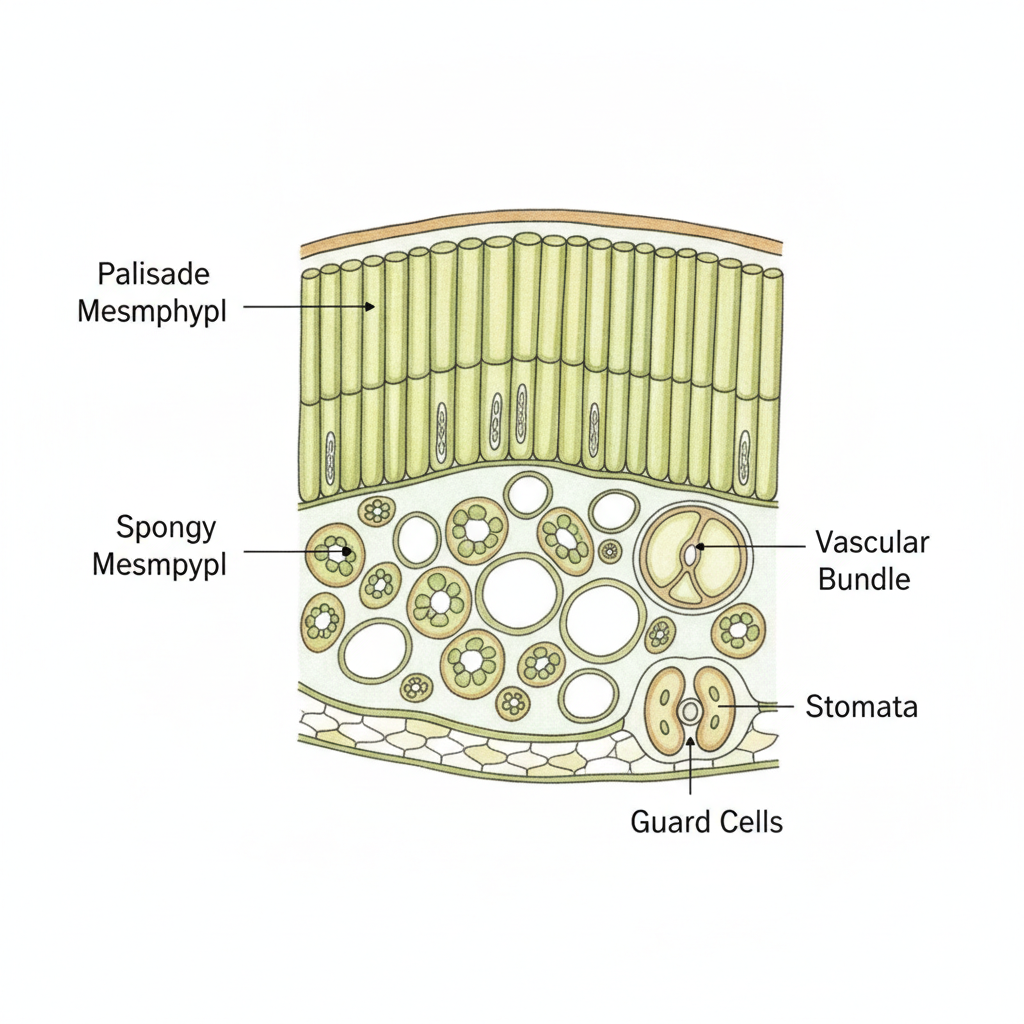
Take a common question: Explain how the structure of a leaf is adapted for efficient photosynthesis. (6 marks)
A Level 1 answer says: "Leaves are green and flat. They have chlorophyll. Photosynthesis makes glucose."
A Level 3 answer says something like:
Leaves are broad and flat, which provides a large surface area for absorbing light. They are thin, so gases have only a short distance to diffuse. The upper epidermis is transparent, allowing light to pass through to the palisade mesophyll cells beneath, which contain the most chloroplasts and therefore carry out most photosynthesis. The spongy mesophyll has air spaces that allow carbon dioxide to diffuse to the photosynthesising cells. Stomata on the underside open to let carbon dioxide in and oxygen out, and guard cells control their opening to reduce water loss. A network of xylem and phloem delivers water for the reaction and removes glucose to the rest of the plant.
Notice what the Level 3 answer does:
- Every feature is linked to a function.
- Every function is linked to why it helps photosynthesis.
- Correct terminology (palisade mesophyll, stomata, xylem, phloem) is used naturally.
- The structure moves logically from outside the leaf inwards, then to transport.
That "feature → function → why it matters" chain is the single most important thing your child can practise.
The mark-scheme language your child should be using
Examiners reward specific vocabulary. If your child writes "the plant takes in CO₂" instead of "carbon dioxide diffuses into the leaf through the stomata," they've lost a mark even though the biology is right.
For each of the four big topics, there is a small bank of terms that should appear:
- Photosynthesis: chlorophyll, chloroplasts, palisade mesophyll, stomata, diffusion, limiting factor, light intensity, carbon dioxide concentration, temperature.
- Respiration: aerobic, anaerobic, mitochondria, glucose, oxygen debt, lactic acid, ATP (energy transferred).
- Homeostasis: receptors, coordination centre, effectors, negative feedback, insulin, glucagon, glycogen, vasodilation, vasoconstriction, sweating, shivering.
- Evolution: variation, mutation, selection pressure, survive and reproduce, pass on alleles, over many generations.
If those words don't appear in an answer on the relevant topic, the answer is capped somewhere in Level 2.
A simple framework parents can use at home
You don't need to know Biology to test your child on this. You need to know what a good answer looks like structurally. Here's a method that works:
1. Ask them the question cold
Pick a past-paper six-marker (all boards publish these free on their websites). Give them six minutes and no notes.
2. Count the "linked points"
A linked point is a because or a therefore — a cause and its effect. Read their answer and count them. For Level 3, you're looking for at least five or six proper cause-and-effect links.
If their answer is mostly single-sentence facts sitting next to each other, that's the problem. It's not a knowledge gap. It's a sequencing gap.
3. Check for the key vocabulary
Using the word banks above, tick off the terms they've used. If more than two or three are missing, they need to redraft.
4. Rewrite together, once
Don't mark and move on. Get them to rewrite the answer with the missing links and vocabulary added. The rewrite is where the learning happens. The original attempt is just the diagnostic.
5. Repeat with the same topic a week later
The goal is that a well-structured six-mark answer on photosynthesis becomes almost automatic. Once they've drafted, redrafted and self-marked the same question three times over a few weeks, the structure becomes muscle memory — and they can apply it to whatever specific angle the exam takes.
Where a tutor helps and where they don't
If your child understands the biology but consistently writes Level 2 answers, the fix is usually structural and can be done at home with mark schemes. If they don't understand the underlying processes — if they can't explain what insulin actually does, or why anaerobic respiration produces lactic acid — no amount of essay practice will help until that gap is closed. That's when one-to-one support is worth considering, because the misconceptions in these four topics tend to be specific and stubborn, and a tutor can find them in a single session.
The one thing to take away
Six-mark questions reward students who can build a chain of reasoning, not students who can list facts. Practise the four big topics — photosynthesis, respiration, homeostasis, evolution — using real past-paper questions and real mark schemes, and insist on the "because... therefore..." structure every time. That single habit shifts more grades in GCSE Biology than any other piece of revision advice.