GCSE English Literature: How to Choose Which Quotes to Memorise — and Which to Ignore
If your Year 11 is sat at the kitchen table copying out thirty quotes from An Inspector Calls, there's a reasonable chance most of them won't earn a single mark in the summer. Closed-book English Literature exams reward quality of selection, not volume. A smaller, sharper quote bank — properly chosen — will do more for a grade than a long list learned in a panic.
Here's how to help your child decide which quotes are worth the effort, and which can be quietly dropped.
Why quote selection matters more than quote quantity
Since the 2015 reforms, GCSE English Literature across AQA, Edexcel, OCR and Eduqas has been closed-book. Students can't take the texts into the exam. That means every quotation on the page comes from memory.
But examiners aren't counting quotes. They're looking for a close, thoughtful response to the text, with evidence that supports an argument. A student who weaves in three well-chosen quotations and analyses them precisely will outscore a student who sprinkles in eight generic ones.
The real skill is choosing quotes that do work — quotes flexible enough to answer whatever question comes up on the day.
The three tests of a quote worth memorising
Before your child commits a line to memory, it should pass at least two of these three tests.
1. Versatility across themes
The exam question is a gamble. For Macbeth, your child might get ambition, kingship, guilt, the supernatural, gender, or appearance vs reality. They can't learn a separate quote bank for each.
The best quotes stretch across several themes. "Look like the innocent flower, / But be the serpent under't" covers appearance vs reality, Lady Macbeth's manipulation, gender, and the supernatural imagery of the serpent. One quote, four possible essays.
Compare that to a single-use quote that only works for one narrow theme. If that theme doesn't come up, the quote is dead weight.
2. Rich language features
A quote earns its place if there's genuinely something to say about how it's written. Look for:
- A clear literary device (metaphor, personification, juxtaposition, pathetic fallacy)
- Striking word choices worth unpacking individually
- Sound patterns (sibilance, plosives, repetition)
- Structural interest (short declarative, question, imperative)
"Marley was dead: to begin with" works because it opens A Christmas Carol with a blunt declarative that foreshadows the entire plot. There's structure, tone, and context to analyse in seven words. That's efficient revision.
A quote with no analysable features — just a line that describes plot — gives the student nothing to say beyond "this shows that…".
3. Character-defining or turning-point moments
Some quotes matter because of when they happen. Sheila's "But these girls aren't cheap labour — they're people" marks her moral awakening in An Inspector Calls. Lady Macbeth's "Out, damned spot!" is the collapse of the character we met in Act 1. These moments anchor an essay in the structure of the whole text, which is exactly what examiners want.
A quote that captures a character at a pivotal moment lets your child discuss change, development, and the writer's intentions — the AO1 and AO3 skills that drive marks.
What to cut
Equally important: what should come off the list.
- Long quotes. Anything over about twelve words is a liability under exam pressure. Learn the key phrase, not the whole speech.
- Quotes with no analysable language. If the only thing to say is "this shows he's angry", drop it.
- Duplicate quotes. If two quotes do the same job for the same theme, keep the stronger one.
- Context-dependent quotes. If understanding the quote requires three sentences of setup, it won't work in a timed essay.
- "Famous" quotes with nothing to add. "To be or not to be" is famous because everyone knows it. That's not a reason to use it unless the student has something genuinely interesting to say.
A good working target is roughly 10–15 quotes per text. For AQA, that's a quote bank of around 40–60 across the Shakespeare play, the 19th-century novel, the modern text, and the unseen poetry anthology — ambitious but achievable across the spring term.
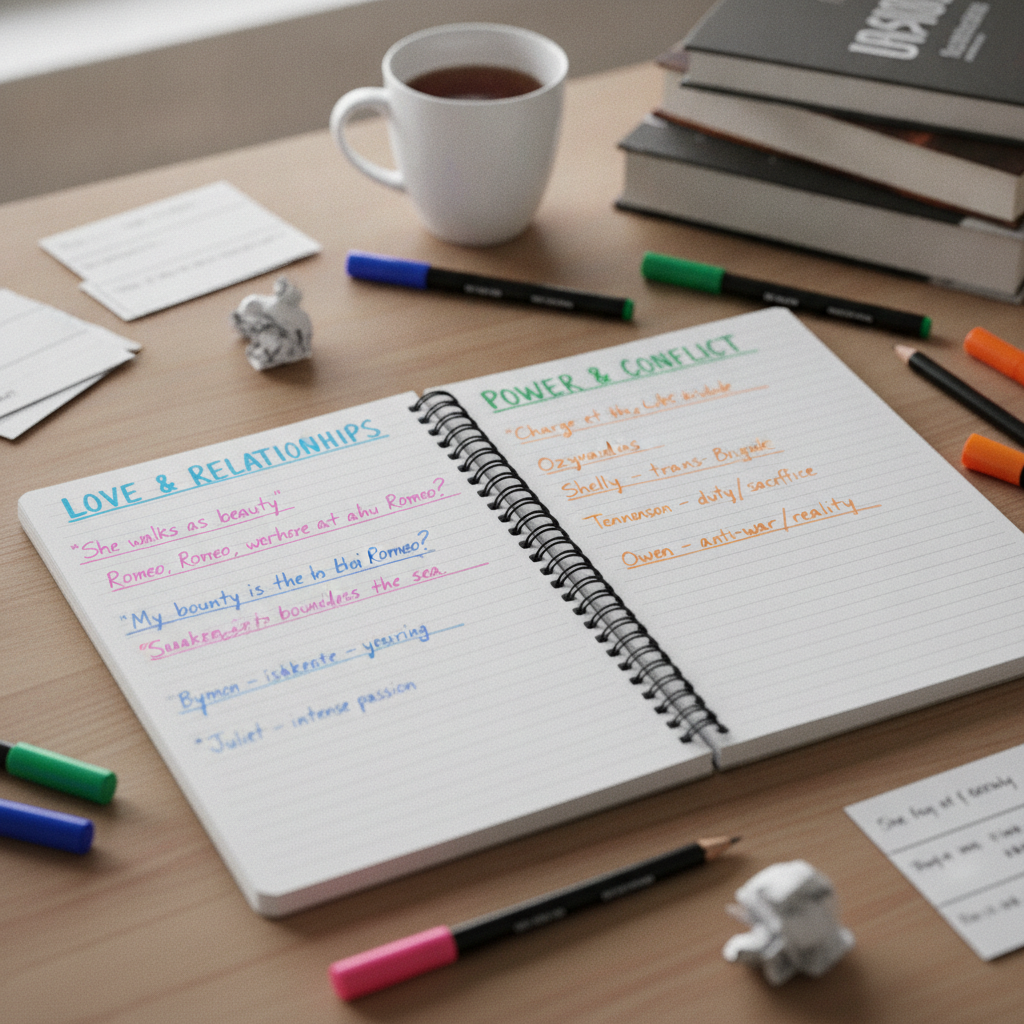
How to audit a quote list
If your child already has a long list, don't throw it out — audit it. Sit down together and go through each quote with three questions:
- Which themes could I use this for? If the answer is one, flag it. If it's three or more, star it.
- What can I actually say about the language? If the student can't name a device or unpack a word, the quote isn't earning its keep.
- Where does it sit in the text? Beginning, middle, end? Pivotal moment or filler?
Rank the quotes. Keep the top ten or so per text. Put the rest in a "maybe" pile and only return to them once the core bank is solid in memory.
This is one of the fastest wins a tutor can deliver in a Year 11 session. An experienced English tutor will look at a quote list and, within half an hour, tell a student which lines are gold, which are passable, and which to abandon. It saves weeks of misdirected revision — particularly for students who are conscientious but working from a list a teacher handed out in Year 10 without much guidance on prioritisation.
Memorising what remains
Once the list is pruned, memorisation becomes manageable. The methods that tend to work:
- Quote-a-day: one new quote in the morning, recited at bedtime, written out the next morning.
- Theme grids: a table with themes down one side and quotes across the top, ticking which quote covers which theme. This doubles as revision for essay planning.
- Quote and comment: write the quote and, underneath, one sentence on the language and one on the theme. If they can't do this from memory, they don't know the quote well enough to use it.
- Past paper application: take a real exam question and plan which three or four quotes would answer it. Rotate questions.
Rote repetition alone is the slowest route. Quotes stick when they're used, not just read.
The honest summary
Memorising quotes is unavoidable at GCSE English Literature, but memorising the wrong quotes is one of the most common revision mistakes in Year 11. A versatile, language-rich, well-chosen quote bank of around a dozen lines per text will serve a student far better than a frantic list of fifty.
If your child is heading into mocks with a bloated quote list and a sinking feeling, the single most useful thing to do this half-term is sit down — with them, or with a tutor — and cut it in half.