GCSE History: Why Year 10 Students Lose Marks on the 16-Mark Essay — and How to Stop It
If your child is in Year 10 and sitting mock papers that come back with comments like "more analysis needed" or "this is descriptive", the 16-mark question is almost certainly where they're haemorrhaging marks. It's the highest-tariff question on the paper, and it rewards a very specific skill that most 14- and 15-year-olds have never been explicitly taught: sustained argument.
The good news is that this is a fixable problem, and the first term of Year 10 is the ideal time to fix it.
What the 16-mark question actually is
All three main exam boards — AQA, Edexcel and OCR — include an extended-response question worth around 16 marks (Edexcel's is 16 plus 4 for SPaG on the thematic paper; AQA's Paper 2 has a 16-marker on the British depth study). The wording varies, but the task is essentially the same:
- "How far do you agree…"
- "'X was the main reason for Y.' How far do you agree with this statement?"
- "Was X the most important factor in…"
The command is always a judgement. The student is being asked to weigh evidence and come down on one side, not to tell the story of what happened.
Why bright students still lose marks
The mark schemes for all boards work on levels — usually four. To reach Level 4 (the top band), a student needs to produce a sustained, analytical argument with a supported judgement. Level 2 rewards description with some explanation. The gap between the two isn't knowledge. It's approach.
Here's what typically goes wrong.
1. They narrate instead of argue
A Year 10 student who knows their content will happily write three paragraphs telling the examiner what happened in, say, the Munich Putsch, the Beer Hall Putsch's aftermath, and Hitler's trial. It reads fluently. It's historically accurate. And it caps out at Level 2, because nowhere does the student say why any of it matters for the question asked.
2. They don't engage with the statement
If the question quotes an interpretation — "Propaganda was the main reason the Nazis stayed in power, 1933–39" — the student needs to interrogate that specific claim. Weaker answers write everything they know about Nazi Germany 1933–39 and hope the examiner joins the dots. Examiners do not join dots.
3. There's no counter-argument
This is the single most common reason capable students stall at Level 3. To reach Level 4, an answer must consider the other side. If the argument is "yes, propaganda was the main reason", the essay must also seriously consider terror, economic policy, or the destruction of opposition — and then explain why propaganda still wins out (or doesn't).
4. The conclusion just repeats the introduction
"In conclusion, propaganda was very important but so were other factors" is not a judgement. It's a shrug. Top-band conclusions reach a clear verdict and justify it against the evidence already presented.
What examiners actually reward
Pulled directly from the language of the mark schemes across boards, Level 4 answers show:
- A clear line of argument sustained from the opening sentence to the conclusion
- Precise, relevant knowledge used as evidence — not decoration
- Genuine analysis of counter-arguments
- A supported judgement that flows from the analysis
Notice what's not on that list: quantity of content, use of every possible fact, long introductions, or historians' quotes (unless the specification requires them, which at GCSE it generally does not).
What good Year 10 practice looks like
The mistake many students (and some schools, under content pressure) make is treating the 16-marker as something to worry about in Year 11. By then, habits have set. The essay skill needs building alongside content, from the first half-term.
Here's what focused practice looks like in the autumn term of Year 10.
Start with the thesis, not the essay
Before writing anything, the student should be able to complete this sentence in one line: "I am going to argue that…" If they can't, they aren't ready to write. This single habit — forcing a judgement upfront — eliminates the narrative drift that costs marks.
Write paragraphs, not essays, at first
A full 16-marker takes 20–25 minutes in the exam. In practice, students learn faster by writing single paragraphs to a tight structure: point, evidence, explanation linked back to the question, and a mini-judgement on how far this factor supports the argument. Ten well-written paragraphs across a fortnight teaches more than two rushed full essays.
Practise the counter-argument in isolation
Give the student a completed one-sided answer and ask them to write the counter-paragraph. This drills the skill without the cognitive load of writing the whole piece. It's also the paragraph most likely to be missing when they do write the whole piece.
Mark against the actual mark scheme
Boards publish mark schemes and examiners' reports on their websites (AQA, Edexcel/Pearson, OCR). The examiners' reports in particular are gold — they spell out, year after year, what weak answers do and what strong answers do. Reading two or three of these with your child is worth more than any revision guide.
Redraft, don't just move on
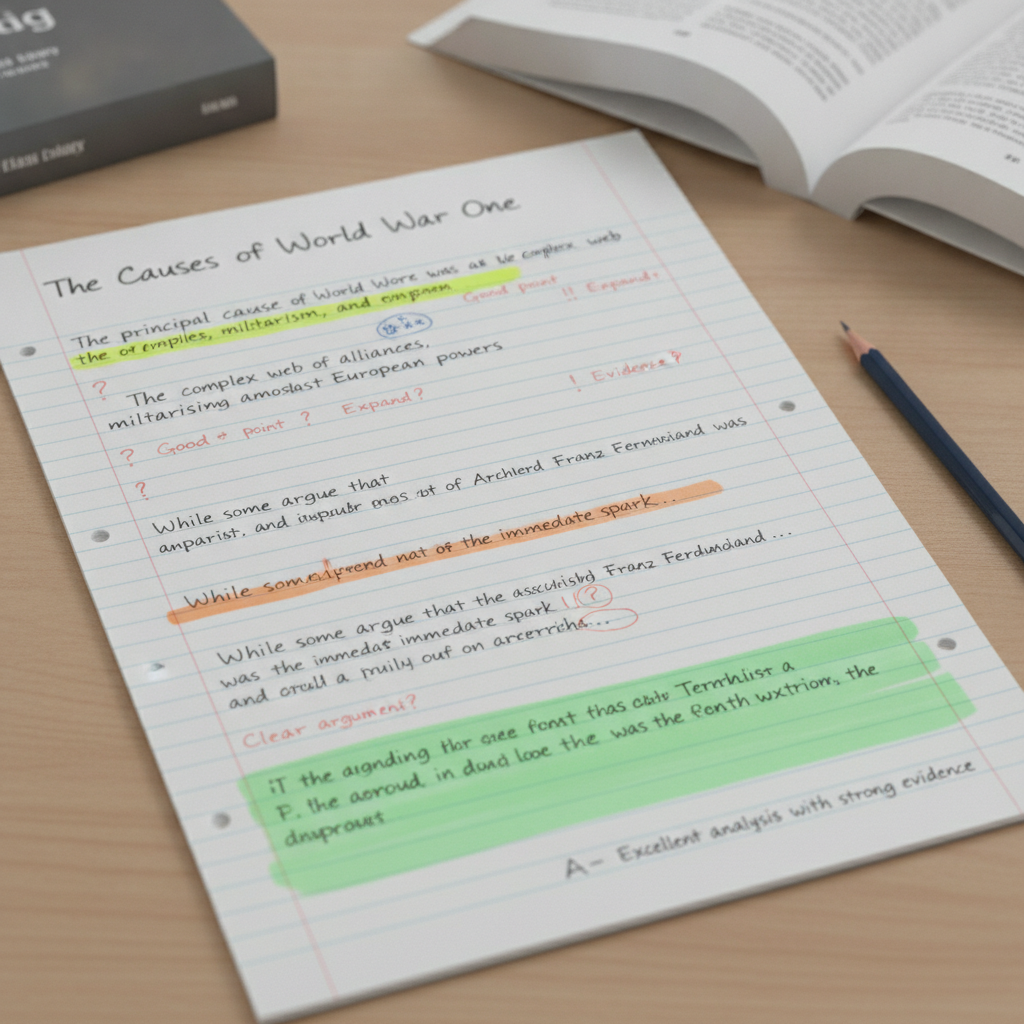
The single most powerful intervention: when a paragraph comes back with a comment, rewrite it. Not tomorrow, not next week. Now, while the feedback is fresh. Most schools don't have time for this in class. It's what parents (or a tutor) can add at home.
How to tell if your child has the skill yet
Ask them, after they've written a practice answer, to summarise their argument in one sentence. If they say "I wrote about the causes of the First World War", they've narrated. If they say "I argued that the alliance system mattered less than Austrian foreign policy, because…", they've analysed. That one test tells you where they are.
A realistic timeline
By the end of the autumn term of Year 10, a student should be writing paragraphs that argue rather than describe. By the spring, they should be producing full 16-markers with a clear thesis, at least one counter-argument, and a genuine conclusion — even if the prose is still rough. Year 11 is then for polish, timing and content revision, not for learning the skill from scratch.
If mocks in January show your child stuck at Level 2 despite solid content knowledge, the issue is almost never revision. It's essay technique — and it responds quickly to focused practice, whether from a supportive teacher, a study partner, or one-to-one work with a tutor who knows the mark schemes. The essay is a learnable skill. Most students just never get shown how.