Is Your Year 11 Child Doing Enough Past Papers — or Just Going Through the Motions?
Ask most Year 11 students how their revision is going and you'll hear some version of "I've done loads of past papers." Ask them what they got wrong on question 4 of the November 2022 Edexcel paper, and you'll usually get a blank look. That gap — between doing papers and learning from them — is where a lot of GCSE grades quietly slip.
Past papers are, without much competition, the most effective single revision tool available. Every teacher, every examiner report, every revision guide says so. But the tool only works if it's used properly, and most 15- and 16-year-olds, left to their own devices, use it badly.
What "going through the motions" actually looks like
If your child is revising alone at the kitchen table, the pattern usually goes like this:
- Print or open a past paper.
- Work through it, sometimes timed, often not.
- Check the mark scheme quickly, tot up a rough score.
- Feel either relieved or deflated.
- Move on to the next paper, or the next subject.
Nothing is written down about what went wrong. The mark scheme is glanced at, not studied. Questions that were half-right get counted as right. Questions that were guessed correctly get counted as understood. Recurring weaknesses — the same type of algebra question, the same kind of source analysis in History — never get identified, so they never get fixed.
The student feels productive. The revision hours are real. But the grade doesn't shift, because the same mistakes keep appearing in the mocks.
What effective past-paper practice looks like
Proper practice is slower and more uncomfortable. It looks roughly like this:
1. Do the paper under proper conditions. Timed, no phone, no notes, no music with lyrics. If the real exam is 1 hour 45 minutes, that's what the practice should be. Rushing through a paper in half the time tells you nothing useful.
2. Mark it honestly, using the mark scheme in full. Not a quick tick-and-cross exercise. Read what the mark scheme actually rewards. GCSE mark schemes are surprisingly specific — they'll say things like "must mention both cause and consequence" or "accept any equivalent form." Understanding what examiners want is half the battle.
3. Read the examiner's report. Every major exam board (AQA, Edexcel, OCR, WJEC) publishes examiner reports alongside past papers. These tell you what most students got wrong and why. They're free and largely ignored.
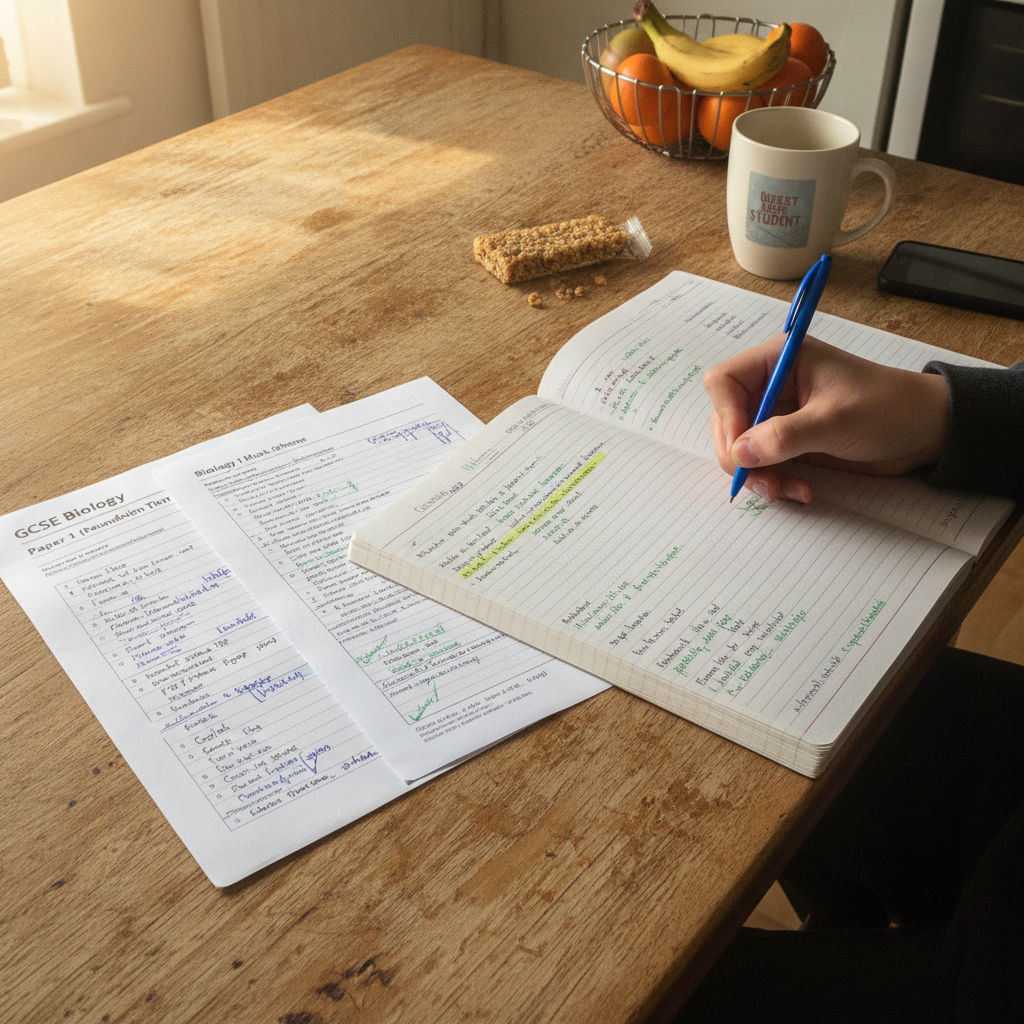
4. Write down every mistake in a "wrong book." A simple notebook, one page per subject, listing the question type, what went wrong, and the correct approach. This becomes the most valuable revision document your child owns by April.
5. Redo the questions you got wrong — a week later. Not immediately. Immediately is easy because the correction is fresh. A week later tests whether it actually stuck.
6. Look for patterns. After three or four papers, weaknesses cluster. It might be quadratics, or unseen poetry, or 6-mark "explain" questions in Biology. Once you can name the weakness, you can attack it specifically.
How many papers by Christmas?
There's no official target, but a realistic guide for a Year 11 aiming at grades 6–9 by the summer:
- Maths: 4–6 full papers per tier by the Christmas holidays, rising to 15–20 in total by May.
- English Language and Literature: 3–4 full papers each by Christmas, plus regular timed essay questions in between.
- Sciences (each of Biology, Chemistry, Physics, or the Combined equivalents): 3–4 papers per subject by Christmas.
- Humanities and MFL: 2–4 papers by Christmas, depending on how paper-heavy the course is.
These are ballpark figures, not rules. A student who thoroughly reviews two papers will learn more than one who races through six. Quality beats quantity every time, but there is a minimum quantity below which the practice simply hasn't been done.
By Christmas of Year 11, your child should have sat at least one full past paper — properly timed, properly marked — in every subject they're taking. If they haven't, they're behind where they need to be.
What a tutor does differently
Self-study past-paper practice tends to plateau because the student doesn't know what they don't know. This is where a tutor earns their fee — not by re-teaching content the school has already covered, but by turning past papers into diagnostic tools.
A good tutor will:
- Watch the student work through questions live, spotting the small errors in method that a mark scheme won't reveal (holding a calculator wrong, misreading command words, showing working in the wrong order).
- Focus on question types rather than whole papers, drilling the specific formats the student loses marks on.
- Use the mark scheme as a teaching document, not just an answer key — explaining why two marks are given here and only one there.
- Track improvement across papers, so weaknesses are addressed systematically rather than randomly.
- Cover the awkward middle ground: questions the student almost got right, which are where most gradable improvement lives.
You don't necessarily need a tutor to do this. A committed student with a supportive parent can replicate a lot of it. But most Year 11s, honestly, will not sit and read an examiner's report on a Sunday afternoon of their own accord.
What parents can do this week
You don't need to know the subject to help. You need to ask the right questions:
- "Which paper did you do? Show me the marked copy."
- "What did you get wrong, and do you understand why?"
- "Which questions are you going to redo next week?"
- "Have you looked at the examiner's report?"
If your child can't answer these, the past-paper practice isn't landing. That's a much more useful signal than a vague "revision is going fine."
The students who improve most between mock and real exams are almost never the ones doing the most hours. They're the ones treating each past paper as a source of information about themselves — and acting on what it tells them.