Is Your Year 8 Child Getting Enough Challenge in English? What to Look For and When to Act
Year 8 is the year that slips past. There are no SATs, no options to choose, no mock exams. Reports come home with reassuring comments — "working well", "a pleasure to teach" — and the assumption is that everything is on track. Often it is. But Year 8 is also the year when the gap between children who are being genuinely stretched in English and those who are coasting starts to widen, quietly, and without much external signal.
By the time Year 9 arrives and GCSE options loom, that gap has usually hardened into something harder to close. So it's worth knowing what strong Year 8 English actually looks like, and what to do if you suspect your child isn't getting there.
Why Year 8 English is easy to misread
Most secondary schools use Year 8 as a consolidation year. Year 7 focuses on settling pupils in and levelling out the range of primary school experiences. Year 9 (or sometimes the second half of it) starts to feel like the runway to GCSE. Year 8 sits in the middle, and the curriculum can feel like a mixed bag: a Shakespeare unit, a novel study, some poetry, a spot of non-fiction writing, perhaps a media or rhetoric module.
Progress in this year is rarely measured against external benchmarks. Teachers assess against the school's own internal criteria, and grades — often something like "working at expected" or a 1–9 flightpath estimate — tend to be stable. A child who was a "5" in Year 7 will usually still be a "5" in Year 8, which parents read as steady progress. It may be. It may also be a child treading water while others learn to swim.
What strong Year 8 English actually looks like
If you want a concrete sense of what a well-stretched Year 8 pupil is doing, look for these three areas.
Reading comprehension beyond the surface
By the end of Year 8, a confident reader should be doing more than retelling what happened in a text. They should be able to:
- Identify a writer's intention and comment on it, not just spot techniques ("simile", "personification") but explain why the writer chose them.
- Track how meaning develops across a whole text — a poem, a chapter, an article — rather than analysing single sentences in isolation.
- Handle unfamiliar vocabulary in context and make sensible inferences about tone, mood, or a character's motivation.
- Read something written before 1900 and get the gist without collapsing. Dickens, Brontë, Stevenson — the language should be effortful but navigable.
If your child's reading homework consistently involves comprehension questions with one-word or one-sentence answers, and they never seem to be asked "why" or "what effect", the work may not be pushing them.
Writing with structure, not just content
Year 8 writing should show a clear shift from primary school habits. Look for:
- Paragraphs that are organised around a single idea and linked to what comes before and after — not just a new line every time the writer changes topic.
- Sentence variety: short sentences for impact, longer complex sentences to develop ideas, deliberate use of subordinate clauses.
- Openings and endings that are consciously crafted. A strong Year 8 story doesn't start "One sunny day…" and a strong Year 8 essay doesn't start "In this essay I will…".
- Some awareness of audience and form. A letter reads like a letter. A newspaper article has a headline, a hook, and a stance.
Spelling and punctuation should be broadly reliable, including semicolons and colons used correctly at least sometimes, and apostrophes in the right places most of the time.
Vocabulary that is actively growing
This is the quietest indicator and often the most telling. A Year 8 pupil being stretched will be picking up new words and using them — sometimes clumsily at first, which is a good sign. If every piece of writing draws on the same 500 words, the reading diet is probably too narrow or the teaching isn't demanding much beyond the familiar.
Warning signs on reports and homework
School reports in Year 8 are often opaque. A few things to look at carefully:
- Effort grades that are high but attainment grades that are only average. This can mean your child is working hard within a comfortable band and not being asked to stretch.
- Comments that focus on behaviour and engagement rather than skill. "Contributes well to discussion" and "always polite" are lovely, but they aren't feedback on English.
- The same targets appearing term after term. "Use more ambitious vocabulary" or "vary your sentence openings" written on three consecutive reports means the target isn't being taught into, it's being noted.
- Homework that is mostly finishing off classwork. Genuine independent reading, wider writing tasks, or vocabulary work are more useful than tidying up unfinished exercises.
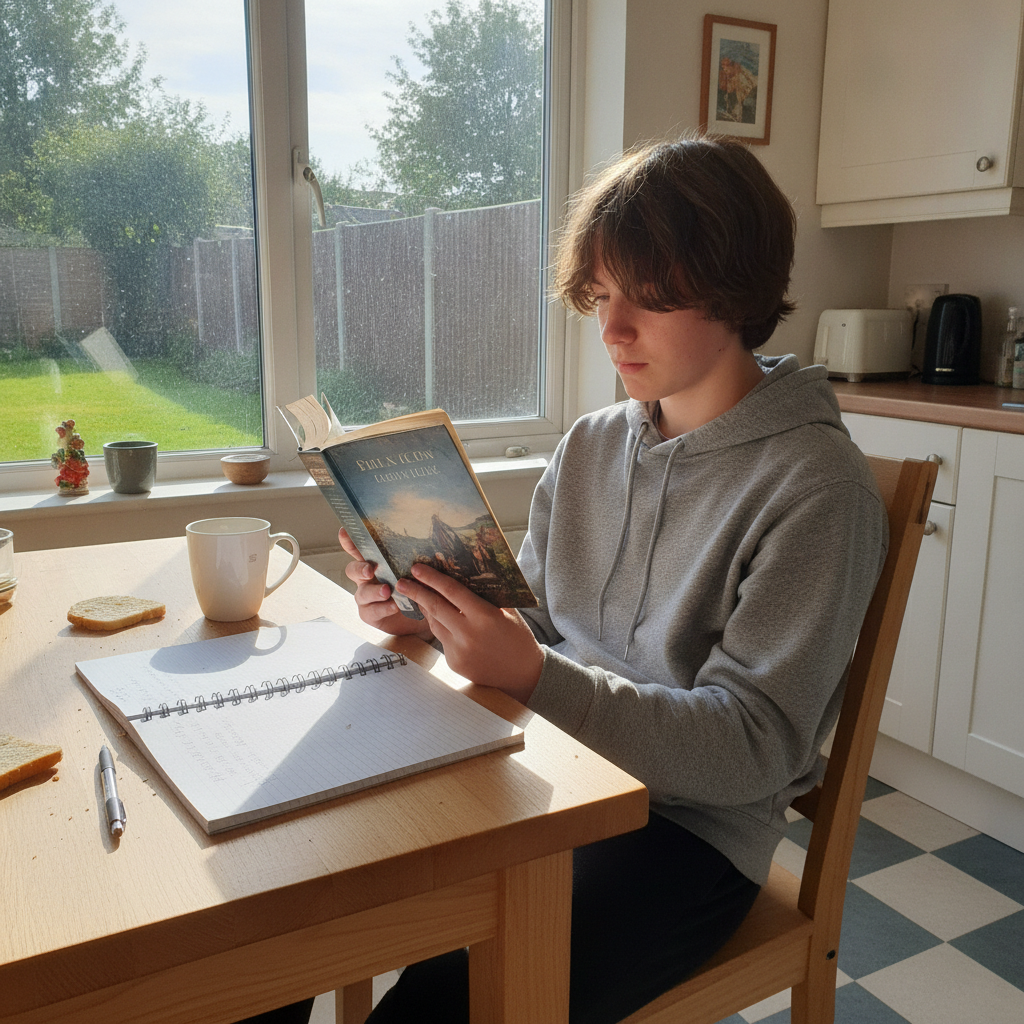
At home, watch what your child reads voluntarily. A Year 8 who reads nothing but graphic novels or short online content isn't necessarily in trouble, but they won't be building the stamina for the long, dense texts GCSE English Literature will demand.
What to do if you're worried
Before assuming your child needs extra help, talk to the English teacher. A short, specific email — "Can you tell me what my child needs to do to move from a 5 to a 6, and what that looks like in their writing?" — will usually get a more useful answer than a general "How are they doing?". If the response is vague, that itself is information.
If you decide targeted support is worth trying, Year 8 is genuinely the right moment. Here's why:
- There's no exam pressure, so a tutor can spend time on foundations — sentence structure, paragraph building, close reading — without racing through content.
- Weaknesses in analytical writing are much easier to fix now than in Year 10, when the GCSE texts are already being taught.
- Reading habits can still be shifted. By Year 10, they've largely set.
Good Year 8 English support isn't about drilling exam technique. It's about widening the range of what a child can read, sharpening how they write, and building the vocabulary they'll need for every subject that involves an essay — history, RE, geography, and eventually English Literature and Language at GCSE.
A short, honest summary
If your Year 8 child is reading widely, writing with some structural awareness, and picking up new words, they're probably fine, even if their grades look middling. If they're producing tidy, safe work that never seems to change much, that's worth taking seriously now rather than at the end of Year 9. The window for building strong English foundations is wider in Year 8 than in any year that follows.
Ask the school a specific question this term. The answer will usually tell you what to do next.