Starting Year 10 in September: What Parents Should Know Before GCSE Coursework and Controlled Assessment Begin
Year 10 feels like a soft landing after the drama of Year 9 options. It isn't. Within weeks of the autumn term, your child will begin work that counts towards their final GCSE grade — and unlike the exams at the end of Year 11, some of this work can't easily be redone if it goes wrong.
Most parents don't realise how early these assessments begin. Here's what to expect and what actually helps.
Which subjects still have non-exam assessment?
Since the Gove reforms of the mid-2010s, most GCSEs are now assessed almost entirely by terminal exams. But a meaningful group of subjects still carries non-exam assessment (NEA) — the umbrella term that replaced "coursework" and "controlled assessment" — and for those subjects, NEA can make the difference between a grade 5 and a grade 7.
The subjects where NEA still matters:
- English Language — a Spoken Language endorsement, reported separately as Pass/Merit/Distinction. It doesn't affect the 9–1 grade but appears on the certificate.
- Art and Design — 60% of the final grade is a portfolio built across Years 10 and 11.
- Design and Technology — a single design-and-make project worth 50%, usually starting in the summer of Year 10.
- Food Preparation and Nutrition — two NEA tasks (a food investigation and a food preparation assessment) worth 50% combined, running through Year 11 but with skill-building throughout Year 10.
- Drama — devised and scripted performance components, typically 60% of the grade.
- Music — performance and composition, 60% of the grade.
- PE — practical performance in three activities plus an analysis coursework piece, 40% of the grade.
- Computer Science — a programming project. It no longer counts towards the grade in most specifications, but schools still require it for certification.
- Modern Foreign Languages — the speaking exam isn't strictly NEA, but it's conducted by the school and often sat before the written exams.
Exact weightings vary by exam board (AQA, Edexcel, OCR, WJEC/Eduqas). The school will be following one specification per subject — it's worth asking which, because the specification document tells you exactly what's assessed and when.
Why the autumn term matters more than parents expect
The instinct is to think of Year 10 as a long runway. In practice, several things kick off in the first half-term:
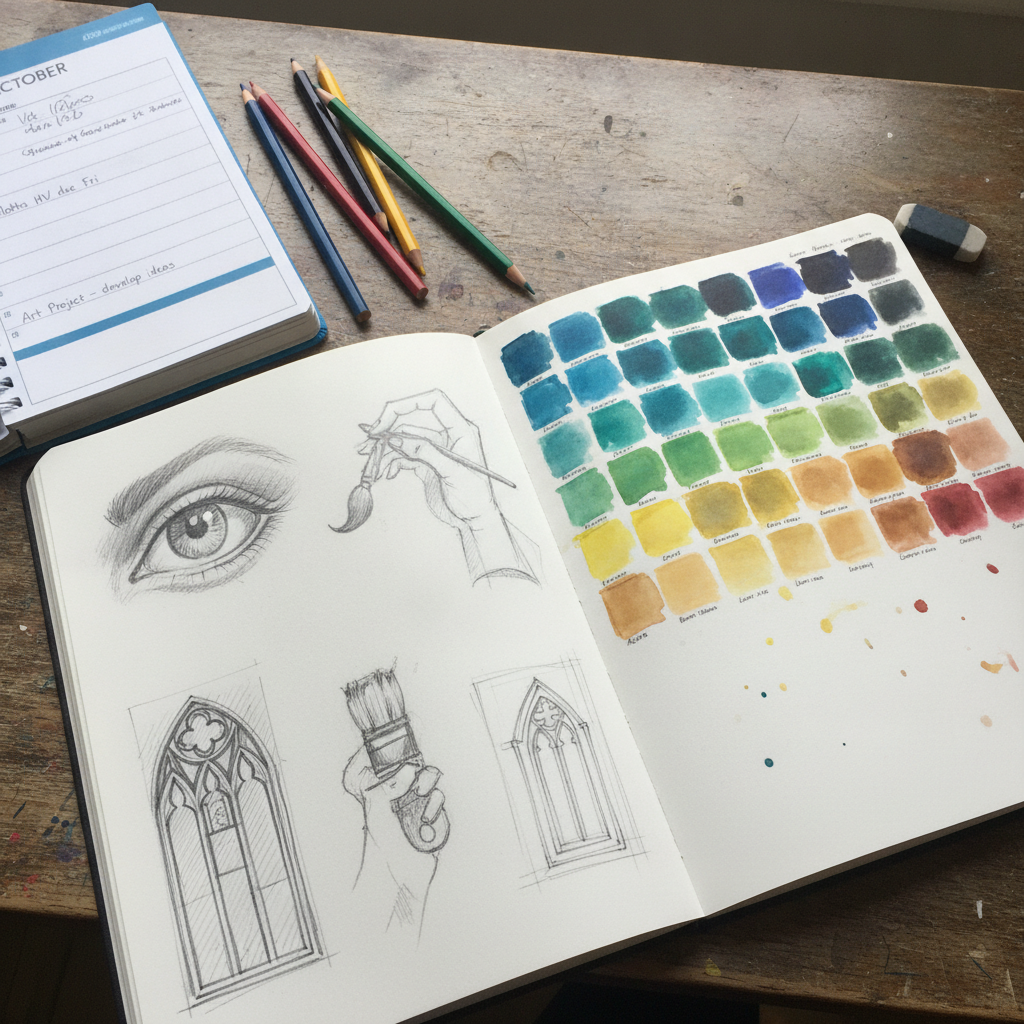
- Art portfolios begin immediately. Every sketchbook page, every study, every experiment is potentially assessable material. Work missed in September can't be recreated with the same authenticity later.
- English Language Spoken Language presentations are often scheduled for the spring of Year 10 but rehearsed from October.
- Drama and Music ensemble work begins in September because performances need months of preparation.
- PE practical moderation depends on evidence gathered across both years, including club participation and match footage.
- Design and Technology contextual research and skill-building starts in the autumn, even if the formal NEA project doesn't begin until later.
The pattern is clear: subjects with a creative or practical element start building the evidence base straight away.
How NEA marks actually factor into the final grade
This is where many families are caught out. If a subject is 60% NEA and 40% exam, a weak portfolio essentially caps the grade — no amount of revision in April of Year 11 will pull it up. Conversely, a strong portfolio gives your child a substantial buffer going into the written papers.
A few things worth understanding:
- NEA marks are moderated, not re-marked. The teacher marks the work; the exam board samples a selection to check standards. This means the teacher's judgement usually stands.
- Deadlines are internal, not external. Exam boards set a window (typically by early May of Year 11), but schools set much earlier deadlines to allow for moderation. Missing an internal deadline can mean the work isn't submitted at all.
- Malpractice rules are strict. Under JCQ (Joint Council for Qualifications) rules, NEA must be the student's own work. Overly involved parental help — particularly with written elements — can invalidate the piece entirely.
Habits worth encouraging from week one
Most of what helps in Year 10 isn't academic tutoring — it's organisation and consistency. A few things that genuinely make a difference:
- A single planner or digital calendar for deadlines. Not one per subject. Every NEA milestone in one place.
- A weekly "photo of progress" for practical subjects. Art teachers often ask for this anyway. It helps you see whether work is actually happening.
- Reading the specification together, once. Twenty minutes on the exam board's website, looking at the assessment objectives for their creative subjects, is time extremely well spent. Students who understand what they're being marked on produce better work.
- Not doing the work for them. Read drafts, ask questions, point out gaps in reasoning. Don't rewrite paragraphs or suggest specific artistic decisions. Beyond the malpractice issue, it means the final grade doesn't reflect what your child can actually do.
- Building in downtime. Year 10 is a two-year marathon. Burning out in November helps nobody.
Where tutoring genuinely helps in Year 10
For NEA subjects specifically, tutoring is most useful for the exam-assessed components — analytical essays in English Literature, the theory paper in Music, the written exam in Food Preparation. A tutor generally can't and shouldn't touch the NEA itself, because the work must be the student's own.
Where it does help: shoring up the underlying skills. A student whose written analysis is weak will struggle with both their English Literature essays and the written commentary in Art. A student whose maths is shaky will find the calculations in Food Prep or the data analysis in PE harder than they need to be. Year 10 is early enough to fix those foundations before Year 11 pressure hits.
The short version
Ask the school, in the first fortnight of term, for a list of NEA deadlines for every subject your child is taking. Put them all in one calendar. Check in monthly rather than daily. Trust the teachers to mark fairly, but know what's being assessed. That's most of the job done.