The GCSE Curriculum Consultation Is Now Open — What It Actually Means for Your Child
I have enough. Let me check one more thing about the specific consultation opening and phase-1 subjects.I have plenty. Now writing the article. Key facts confirmed:
- Consultation on draft programmes of study for KS1-3 and first group of GCSEs opens September 2026 (the brief says "this September" — treating as the current news)
- Revised national curriculum published Spring 2027
- First teaching new national curriculum: September 2028
- Reformed GCSEs: first phase first teaching September 2029, second phase 2030
- First exams therefore around 2031 (phase 1)
- Review led by Prof Becky Francis
- Government response published Nov 2025
- Recommendations: cut GCSE exam time by ~10%, scrap EBacc measure, Year 8 diagnostic tests, formula sheets kept
What the consultation is — and what it isn't
The Department for Education has opened a public consultation on the draft programmes of study for the first tranche of reformed GCSEs. It runs alongside a parallel consultation on the revised national curriculum for Key Stages 1 to 3. If you have a child in primary or the first years of secondary, this is the piece of policy that will shape what they actually study.
A consultation is not a decision. It is a formal window — usually several weeks — in which the DfE publishes draft content and invites responses from teachers, school leaders, exam boards, subject associations, universities, employers and, yes, parents. Officials then analyse the responses, adjust the drafts, and publish the final version. In this case, a public consultation on the draft programmes of study and subject content for the first group of GCSEs will open this September, with the revised curriculum expected the following spring.
So nothing your child is studying today is changing because of this. What is being decided now is the syllabus they may sit later this decade.
The timeline, in plain English
The reform is being rolled out in stages. The final curriculum will be published in spring 2027, and schools will start teaching it from September 2028. The DfE proposes reforming GCSEs and A-levels in two phases each: first teaching of the first phase of GCSEs will be in 2029, and the second phase in 2030.
Because GCSE courses run for two years, the first cohort to sit the new phase-one GCSEs will take their exams in summer 2031. The second phase follows in 2032.
That gives us a rough map:
- September 2026 — consultation opens on draft programmes of study
- Spring 2027 — final revised national curriculum published
- September 2028 — new national curriculum begins teaching in primary and Key Stage 3
- September 2029 — first phase of reformed GCSEs begins teaching in Year 10
- Summer 2031 — first exams sat under the new phase-one GCSEs
- September 2030 / Summer 2032 — second phase of reformed GCSEs
Which children are affected?
This is the part most parents actually want to know. The honest answer depends on your child's year group in September 2025.
Year 11 and above — nothing changes
Your child is sitting their GCSEs under the current specifications. The reforms will not touch their courses, their exams, their grades or their timetable. Any headlines about "new GCSEs" refer to a system their younger siblings will meet, not them.
Year 10 — nothing changes
Year 10s in 2025–26 are already partway through the current GCSE courses and will sit them in summer 2027. They finish well before any new specification is introduced.
Year 9 — almost certainly unaffected
Year 9s starting GCSE options this year will begin Year 10 in September 2026 and sit exams in 2028, still under current specifications. The reformed GCSE specifications, the actual content and assessment structure, won't begin first teaching until September 2029 at the earliest, with a second phase of subjects following in September 2030.
Year 8 — likely the first affected cohort, but only in some subjects
A child in Year 8 in September 2025 will be in Year 10 in September 2027 for most current qualifications, but if their school waits and they start Year 10 in September 2029, they could be among the first to sit the reformed phase-one GCSEs. The picture will depend on school timetabling and which subjects your child takes.
Year 7 — will meet the new curriculum first at Key Stage 3, then reformed GCSEs
Year 7s in 2025–26 will move into Key Stage 3 lessons taught under the revised national curriculum from September 2028 (their Year 10 year, depending on subject phasing) and are the clearest candidates to sit reformed GCSEs across most subjects.
If in doubt, ask your child's school. Secondary schools will begin planning for the transition long before parents receive formal notice.
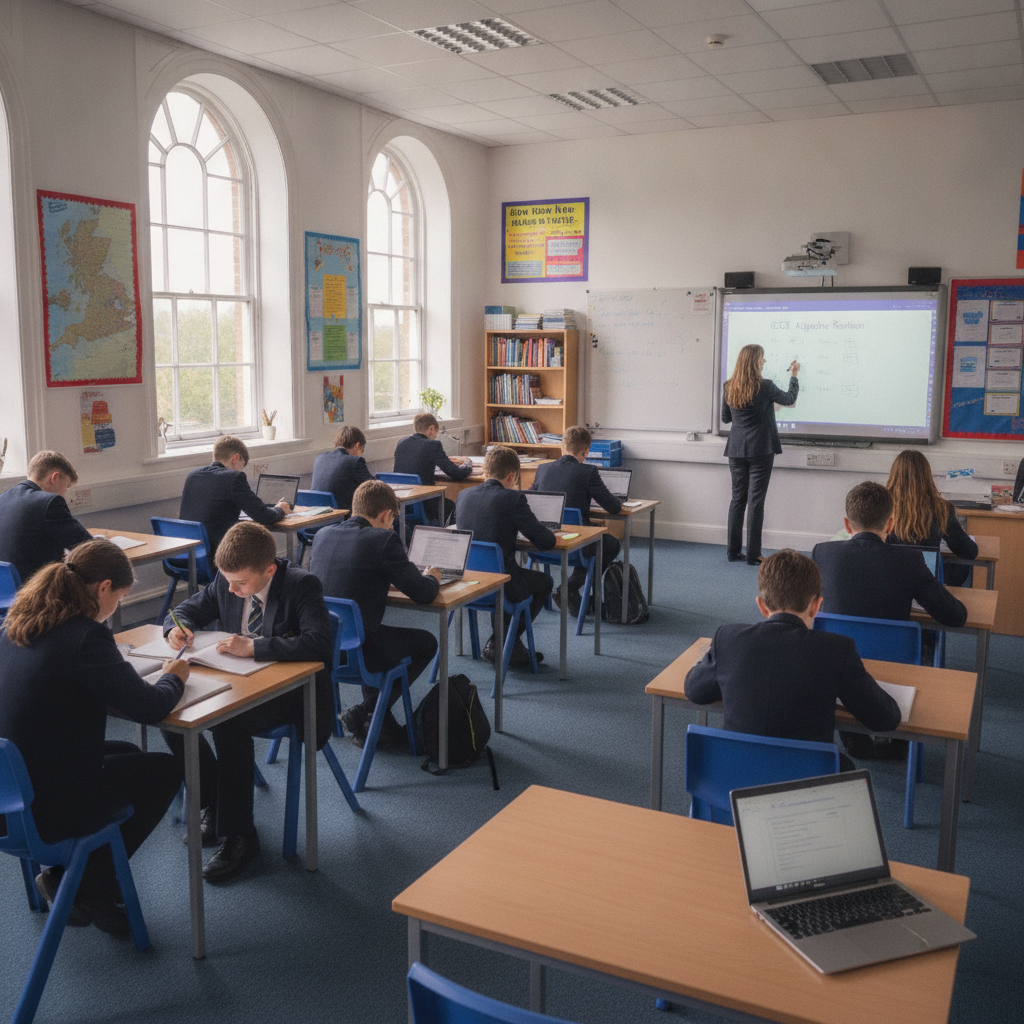
What the reforms are likely to change
The consultation drafts have not yet been published in full, but the direction of travel is clear from the Curriculum and Assessment Review's final report, chaired by Professor Becky Francis and published in November 2025, and the government's response the same day.
Expected changes include:
- Slightly shorter exams. The Review calls for a reduction in overall GCSE exam time by at least 10%. That is roughly two hours less across a full set of GCSEs.
- A broader knowledge base with more diverse content. Where appropriate, the corresponding GCSE subject content to include stronger representation of the diversity that makes up our modern society, allowing more children to see themselves in the curriculum.
- Formula and equation sheets retained in maths, physics and combined science, following an earlier consultation that showed overwhelming support.
- Changes to accountability measures. The government should scrap the EBacc accountability measure, introduce year 8 "diagnostic" tests. The EBacc is the performance measure that has pushed schools to enter pupils for a specific set of academic subjects; removing it changes how schools shape their options blocks, though the subjects themselves remain available.
- A knowledge-rich approach retained. The DfE has accepted the review's recommendation that the curriculum should keep a knowledge-rich approach and should support students to master core concepts, build knowledge and deepen understanding.
Individual subjects will have their own detailed changes — in maths, for example, expect resequencing of content across Key Stages 1 to 3 and shorter papers.
What the consultation means for parents in practice
Three sensible things to do, and one thing not to do.
Do:
- Read the drafts if you have the time. They are published on the gov.uk consultation pages. Subject teachers will be reading them closely; you can too.
- Respond if you want to. Parents are a legitimate audience for consultations. If you have views on content, workload or fairness, submit them through the online form during the window.
- Talk to your child's school. By 2027–28, senior leaders will be planning schemes of work under the new programmes of study. They will know before you do how the transition will land in your particular school.
Don't rush to change tutors, textbooks or revision plans on the strength of a draft. The current GCSE specifications will remain in force for years. A Year 8 pupil starting revision now is still preparing for the exams that exist today, not a hypothetical version of them.
The bottom line
For most families reading this, the consultation is important background rather than urgent news. If your child is in Year 10 or 11, nothing changes. If your child is in Year 7, 8 or 9, the reforms are worth following, but no action is required until draft specifications are published by the exam boards — likely in 2028. The consultation itself is a chance to shape the detail before it is set. That is genuinely useful, and worth engaging with, but it is not a reason to change what your child is doing this term.