The SEND White Paper Consultation Closes This Week — What It Means for Your Child
Two key consultations closing 18 September 2026: (1) upfront funding / local SEND inclusion formula, and (2) education otherwise than at school (EOTAS). The main SEND consultation closed 18 May 2026. Four-tier model: Universal, Targeted, Targeted Plus, Specialist. Legislation not expected before September 2029.
The 2026 Schools White Paper — Every Child Achieving and Thriving — sets out the biggest changes to Special Educational Needs and Disabilities (SEND) provision in more than a decade. Two Department for Education consultations tied to that reform close at 11:59pm on 18 September 2026, and if your child has an Education, Health and Care Plan (EHCP), is on SEN Support, or is waiting for an assessment, the direction of travel matters.
Here is what is actually being proposed, who is likely to be affected, and what a parent can usefully do this week.
What the White Paper actually proposes
The White Paper was published on 23 February 2026. Its headline SEND proposal is a move away from the current two-category system — SEN Support in mainstream, or an EHCP for statutory provision — towards a graduated model with four levels.
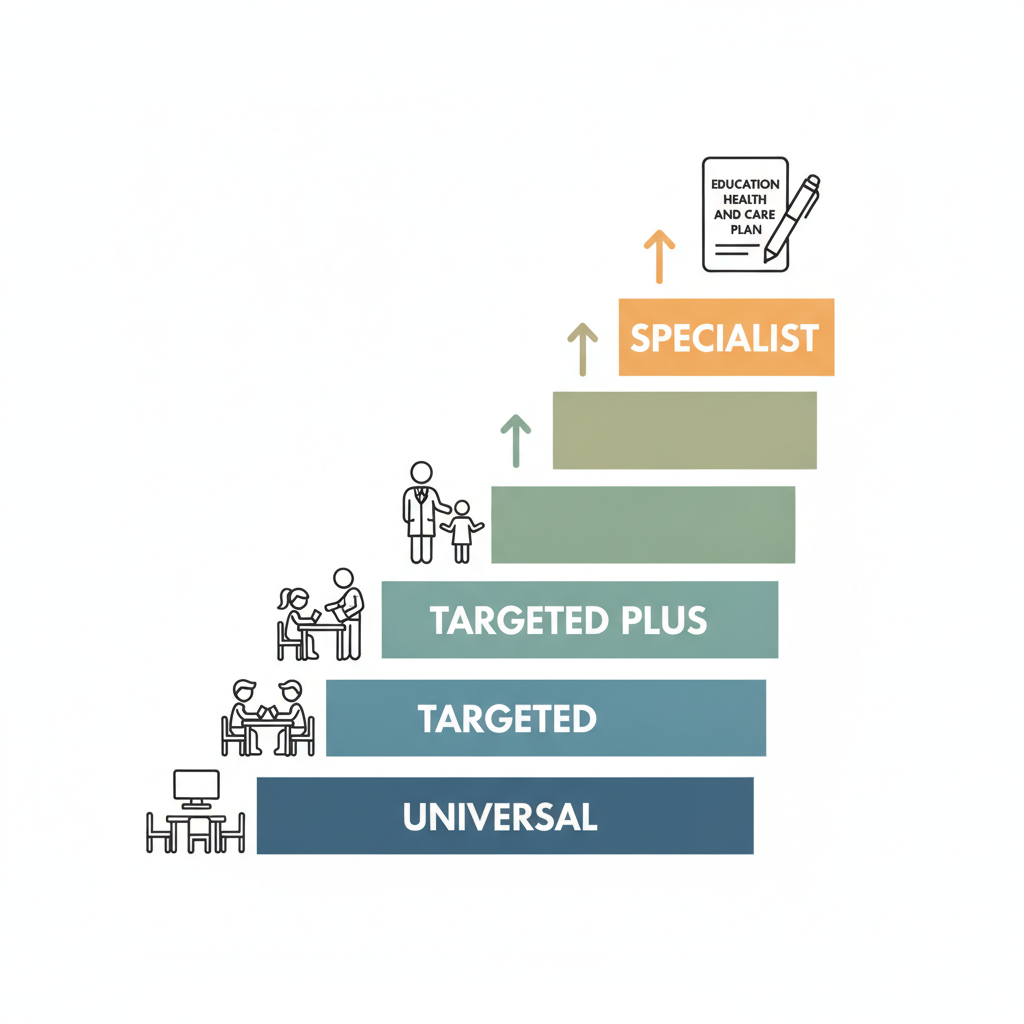
The White Paper proposes replacing the current two-category system (SEN Support, then an EHCP) with four levels of support: universal, targeted, targeted plus and specialist. In shorthand:
- Universal (Tier 1): high-quality adaptive teaching for every pupil in the classroom.
- Targeted (Tier 2): school-led interventions such as small-group work or structured support.
- Targeted Plus (Tier 3): sustained, specialist involvement for pupils with more complex or persistent needs who may not need an EHCP, often including regular input from external professionals.
- Specialist (Tier 4): for children with the most complex needs. Those receiving specialist support will be entitled to an EHCP.
Alongside the tiers, all schools and other educational settings would create digital Individual Support Plans for any child or young person with identified SEND, whether or not they have an EHCP. The intention is that a plan follows the child, is visible to staff and parents, and is updated as needs change.
Why the government says change is needed
Demand for EHCPs has risen sharply since the 2014 reforms, and high-needs budgets in most local authorities are in deficit. The White Paper's answer is to build up mainstream provision so that fewer children need to escalate to a statutory plan to get help. Pupils with only the 'most complex needs' will require EHCPs by 2035 under the proposals.
This is where much of the parental anxiety sits. The concern, voiced by SEND charities and by many parents through the spring consultation, is that "most complex" will be interpreted narrowly, and that children currently on the borderline — those with moderate autism, ADHD, dyslexia, speech and language needs or SEMH (social, emotional and mental health) difficulties — could be pushed down into Targeted or Targeted Plus provision without the legal protection an EHCP currently carries.
What happens to existing EHCPs
This is the question I get asked most. The short answer is: nothing changes immediately.
The reformed system needs legislation and is not expected to take effect before September 2029, with no changes to existing EHCP support before then. New needs assessments would begin from September 2029 for children having their first assessment, with separate arrangements for those already holding plans.
In practice, that means:
- If your child already has an EHCP, the annual review process, the plan itself, and your right to appeal to the SEND Tribunal continue as now.
- If you are mid-assessment, the current statutory timescales still apply.
- The four-tier model is a proposal, not law. Parliament will need to pass primary legislation before any of it becomes binding.
That does not make the consultation irrelevant. The White Paper sets the direction of travel, and the guidance and funding rules that flow from it will start shaping decisions in local authorities long before 2029.
The two consultations closing on 18 September
The main White Paper consultation — SEND reform: Putting Children and Young People First — closed on 18 May 2026. Two follow-up consultations opened in July and close this week.
1. Upfront funding for mainstream schools: creating a 'local SEND inclusion formula'
Published on 10 July 2026, this consultation looks at how local authorities could give mainstream schools a larger share of SEND funding up front, rather than schools having to fund the first £6,000 of additional support per pupil themselves before drawing on high-needs money. This would allow local authorities to test arrangements for giving mainstream schools more SEND funding upfront during the 2027 to 2028 financial year.
The DfE says that this consultation is for local authorities, mainstream schools, "representatives of school funding and finance arrangements," and parent carers. Parents can respond.
2. SEND reform: education otherwise than at school (EOTAS)
This consultation covers children whose EHCPs deliver provision outside a school setting — often after placement breakdowns or where no suitable school exists. The DfE has said children and young people of secondary school age and above who are already receiving EOTAS when any new system comes in will have their arrangements protected, but the future shape of EOTAS is very much in play.
Both consultations sit on the gov.uk Citizen Space platform and can be responded to online.
Who is most likely to be affected
Based on what the White Paper says now, three groups of parents should be paying particularly close attention.
Parents of children currently on SEN Support without a plan
Under the proposals, your child would sit at Targeted or Targeted Plus, with a digital Individual Support Plan rather than a statutory EHCP. The quality of that provision will depend heavily on how the four tiers are defined, funded and inspected. This is arguably the group with most to gain — or lose — from the detail.
Parents of children with moderate needs currently seeking an EHCP
If EHCPs are eventually reserved for the most complex needs, the threshold for a statutory plan is likely to rise. Existing statutory rights remain in force for now, but families beginning the assessment process should keep careful records and take advice from an experienced SEND practitioner if a refusal to assess arrives.
Parents of children receiving EOTAS or in independent special schools
The EOTAS consultation directly concerns your child's arrangements. The White Paper also proposes stronger oversight of Independent Special Schools, which for some families will be reassuring and for others will raise placement concerns.
What to do before the deadline
If you want your voice on the record before Friday, there are three practical routes.
-
Respond directly to one or both consultations. The two open consultations — on upfront mainstream funding and on EOTAS — are on gov.uk. Both close at 11:59pm on 18 September 2026. You do not need to answer every question; partial responses count. Focus on the questions where your family's experience adds something the DfE will not hear from officials.
-
Feed into a charity submission. Organisations including IPSEA, SOS!SEN, Contact and Special Needs Jungle are collating parent views and will submit detailed responses of their own. If drafting your own answers feels daunting, sharing your experience with one of them is a legitimate way to be heard.
-
Write to your MP. The reforms require primary legislation. Your MP will be asked to vote on the resulting Bill, probably in the next parliamentary session. A short, specific letter — one child, one experience, one ask — carries more weight than a long general one.
Practical steps for the next school year, regardless of the reforms
Whatever the White Paper eventually becomes, the school year now underway will be governed by the existing law: the Children and Families Act 2014 and the current SEND Code of Practice. That means:
- Ask for your child's provision to be recorded in writing at the next SEN meeting, whether they have an EHCP or SEN Support.
- If an annual review is due this term, request draft amendments in writing and check the statutory timescales.
- If your child is falling behind academically because support is not being delivered, address the gap directly. Catch-up work — through school interventions, targeted small-group support, or one-to-one tutoring where a specific subject weakness has opened up — does not depend on which tier your child sits in.
- Keep a dated log of contact with the school and the local authority. If the system does change in 2029, that paper trail will matter.
The bottom line
The SEND White Paper is a serious attempt to rebuild a system that most people — parents, schools and local authorities — agree is not working. Whether the four-tier model delivers on that ambition depends on funding, workforce, and how narrowly "most complex needs" is defined in the legislation to come.
Nothing changes for your child this term. But this week is one of the few moments when parental voices can shape the detail before the DfE writes its response. If you have five minutes and an internet connection, you have enough to be part of it.