Year 8 Maths: The Topics That Quietly Derail GCSE Prospects — and How to Spot Them Now
Year 8 is the year GCSE Maths results are quietly decided. Not because the content is especially hard, but because it's the year the curriculum shifts from arithmetic to abstract reasoning — and pupils who paper over the cracks at this stage tend to hit a wall in Year 10.
By then, the gaps are two or three years deep, and the tutor's job is no longer "top up understanding" but "rebuild the foundation while keeping up with new content". That's an expensive, stressful position to be in. The good news is that the topics where things go wrong are predictable, and you can check where your child stands in a single afternoon.
Why Year 8 matters more than Year 10
In Year 7, most pupils are still working with familiar numbers: whole numbers, simple fractions, straightforward operations. The transition into Year 8 introduces the abstract machinery that GCSE depends on — manipulating unknowns, working proportionally, handling negatives fluently, and moving between fractions, decimals and percentages without pausing to think.
If a Year 8 pupil is getting reasonable marks in class tests but relying on memorised procedures rather than understanding, this often doesn't show up until GCSE questions start combining topics. A foundation paper question on percentage change inside a ratio problem, for instance, will expose a shaky grasp of either topic instantly. In Year 8, the same pupil might get 70% on a topic test and everyone assumes things are fine.
The four topics where understanding usually breaks
1. Negative numbers
The classic trip-hazard. Most pupils can tell you that two negatives make a positive — but ask them why, or give them something like -3 - (-5) + (-2), and confidence evaporates. The problem gets worse when negatives appear inside algebra: expanding -2(x - 4) is a routine source of lost marks all the way through GCSE.
Secure understanding looks like: the pupil can explain what's happening on a number line, handles negatives inside brackets without hesitation, and doesn't slow down when a negative appears mid-calculation.
Surface familiarity looks like: they get simple examples right but freeze when negatives appear in unfamiliar contexts, or they recite rules ("minus minus is plus") without being able to apply them consistently.
2. Fractions
Fractions are the topic pupils most often think they understand. Adding and subtracting with different denominators, dividing by a fraction, and — the big one — working with fractions of fractions (e.g. "what is two-thirds of three-quarters?") are where things quietly go wrong.
At GCSE, fractions turn up inside almost every other topic: probability, algebra, ratio, gradients, trigonometry. A weak grasp here doesn't just cost marks on fraction questions; it slows everything else down.
Secure understanding looks like: the pupil can add 2/3 + 3/5 without a calculator, explain why you flip and multiply when dividing, and comfortably work with mixed numbers.
Surface familiarity looks like: they can do fractions when a worksheet says "fractions" at the top, but revert to decimals or calculators when fractions appear inside a word problem.
3. Ratio and proportion
Ratio is the topic that separates confident GCSE candidates from struggling ones more sharply than any other. It appears everywhere — recipes, scale drawings, best-buy problems, similar shapes, compound measures, probability. Year 8 is when ratio moves from "share £40 in the ratio 3:5" to unequal sharing, ratio as fractions, and combining ratios.
Secure understanding looks like: the pupil sees a ratio and immediately thinks about the total number of parts, can convert between ratios and fractions, and can solve problems where they're given one part rather than the total.
Surface familiarity looks like: they can do the "share this amount" question but stumble when the question gives them the smaller share and asks for the larger, or when the ratio needs simplifying first.
4. Early algebra
Year 8 is when letters start behaving like numbers. Pupils need to collect like terms, expand single brackets, substitute into expressions, and solve linear equations with unknowns on both sides. The conceptual leap is understanding that x is a number you don't know yet — not a label, not a mystery symbol, and not the same thing as a variable in a formula.
Secure understanding looks like: the pupil can explain why 3x + 2x = 5x (not just that it does), can solve 2x + 5 = 3x - 4 without prompting, and understands that x² and 2x are different things.
Surface familiarity looks like: they follow examples in class but can't start a problem from scratch, or they confuse expressions with equations, or they treat 2x and x + 2 as interchangeable under pressure.
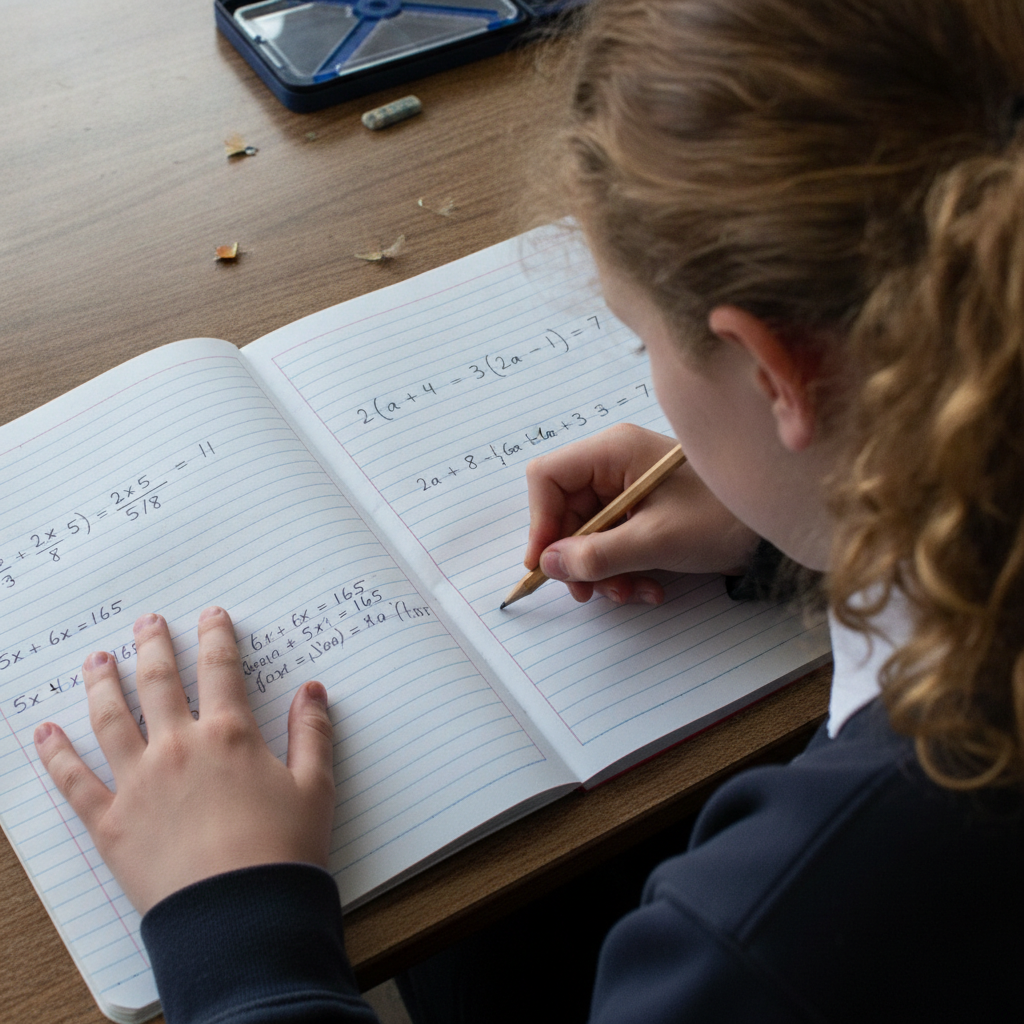
Two ways to check where your child actually stands
Here are two practical checks you can do before September. Neither requires you to remember any maths yourself.
Check 1: The 20-minute conversation test
Sit down with your child and ask them to explain, not solve, five things:
- Why does dividing by a fraction make the answer bigger?
- What does the "2" in
2xmean? What about the "2" inx²? - If a recipe uses flour and sugar in the ratio 3:2 and you have 600g of flour, how would you work out the sugar?
- What is
-4 - -6, and can you draw a number line to explain it? - What's the difference between 40% of £60 and £60 increased by 40%?
You're not looking for perfect answers. You're listening for whether they can reason out loud, or whether they immediately reach for a rule they can't quite remember. Hesitation on the reasoning is the tell.
Check 2: A KS3 diagnostic paper
Both major exam boards publish Key Stage 3 assessment materials, and there are free past White Rose and Corbettmaths end-of-Year-8 papers online. Print one, give your child 45 minutes, and — this is the important part — mark it yourself against the mark scheme.
Don't just look at the total. Look at where they lost marks. If the losses cluster on the four topics above, you have your answer. If they lost marks across the board on method rather than content, that's a different (and usually easier) problem.
What to do with what you find
If the gaps are small and topic-specific, targeted practice over the summer — 20 to 30 minutes, three or four times a week, on one topic at a time — will usually close them. Corbettmaths, Dr Frost Maths and Sparx all have free structured practice for this.
If the gaps are broader, or if your child can't explain their reasoning even on topics they get right on paper, that's when a tutor genuinely earns their fee. The value isn't in extra practice — your child gets that at school. It's in someone sitting with them, listening to how they think, and rebuilding the connections that class pace didn't allow time for.
The Year 8 gaps are almost always fixable. They just aren't fixable if no one notices them until Year 10.